
Introduction
Students often learn complex concepts through textbooks, lectures, worksheets, and classroom discussions. These methods provide important foundations, but learners may still struggle to understand how academic knowledge applies to real situations. Educational simulations help bridge this gap by allowing students to explore realistic scenarios, make decisions, observe outcomes, and learn from their experiences.
From conducting virtual science experiments to managing a simulated business, these activities give students opportunities to apply knowledge in an interactive environment. Rather than simply reading about a concept, learners can investigate how it works and see how different decisions affect the results.
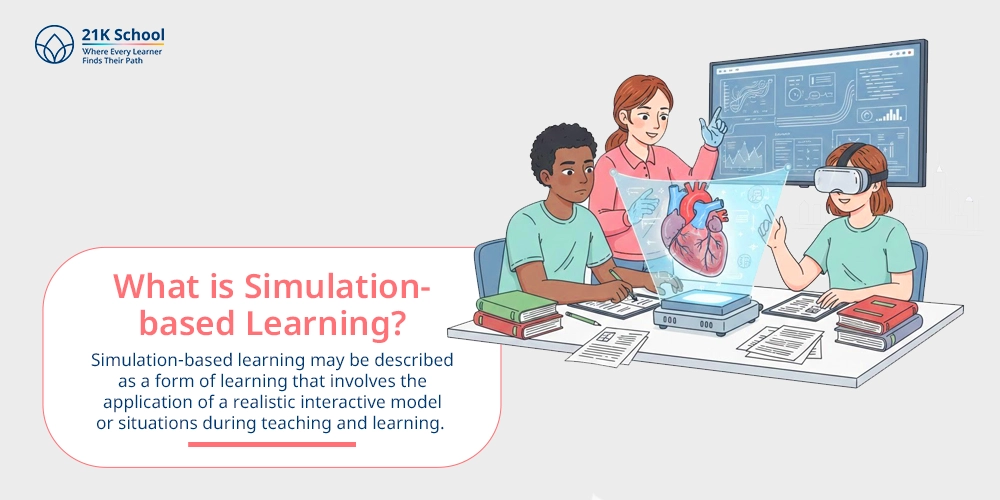
Educational simulations for students are structured learning experiences that recreate real-world processes, situations, or systems for educational purposes. They may use digital software, interactive models, role-playing activities, classroom exercises, or physical equipment. Their main purpose is to help learners develop understanding and practical skills through guided experimentation.
When teachers use simulations alongside clear learning objectives, instruction, and reflection, students can develop stronger problem-solving abilities, critical thinking, collaboration, and confidence. These activities can also make difficult concepts easier to explore by allowing learners to practice in a controlled environment.
What Are Educational Simulations?
Educational simulations reproduce selected features of real-world situations so that students can investigate how a process works or practice responding to a challenge. A simulation may represent a natural phenomenon, a professional task, a social situation, or a complex system.
For example, a science simulation might allow students to change the temperature of a substance and observe how its behavior changes. A business simulation could ask students to set prices, manage expenses, and respond to customer demand. A history simulation might place learners in the role of community leaders who must make decisions during a historical crisis.
Although simulations vary in format, they generally share several features:
- A realistic or simplified scenario: Students explore a situation connected to a real process, problem, or decision.
- Active participation: Learners make choices, change variables, perform tasks, or interact with other participants.
- Observable outcomes: Students receive information about the effects of their actions.
- Opportunities for experimentation: Learners can test different approaches and compare results.
- Reflection and feedback: Teachers guide students in understanding what happened and why it matters.
A simulation does not need to reproduce every detail of reality. In many cases, simplifying a situation makes it easier for students to focus on the most important concepts.
The key is to design an activity that represents the learning goal accurately enough to support meaningful conclusions.
Why Educational Simulations Matter in Modern Education
Modern education aims to help students develop more than factual knowledge. Learners also need to interpret information, evaluate alternatives, communicate ideas, and apply what they know in unfamiliar situations.
Educational simulations provide opportunities to practice these abilities.
Connecting Theory With Practice
Students may understand a scientific principle in theory but find it difficult to recognize how it operates in practice. Simulations allow them to apply that principle and observe its consequences.
For instance, students learning about electricity can use a virtual circuit model to connect components, change resistance, and observe how the current responds. This experience helps connect abstract scientific ideas with visible outcomes.
The teacher can then relate the simulation to equations, diagrams, and physical experiments, helping students develop a more complete understanding.
Making Abstract Concepts Easier to Understand
Some concepts are difficult to observe directly. Atoms, planetary motion, economic systems, and long-term environmental changes may be too small, too large, too slow, or too complex to study through ordinary classroom observation.
Simulations can represent these processes visually and allow students to adjust variables. Learners can investigate how planetary orbits change, how populations respond to environmental conditions, or how supply and demand influence prices.
These representations can make difficult ideas more accessible, particularly when teachers explain what the model shows and where its limitations lie.
Providing a Safe Environment for Practice
Some real-world activities involve risks, expensive equipment, or consequences that cannot easily be reversed. Simulations let students practice decisions without exposing themselves or others to unnecessary danger.
A learner can rehearse emergency procedures, test a virtual laboratory setup, or practice responding to a difficult workplace situation before encountering a comparable real task.
This controlled environment also makes it easier to repeat activities, examine mistakes, and try alternative approaches.
However, simulations should not automatically replace hands-on training where physical practice is essential. They are often most useful as preparation for, or a complement to, real experiences.
Types of Educational Simulations for Students
Teachers can select from different simulation formats depending on the subject, students’ age, available resources, and learning objectives.
1. Computer-Based Simulations
Computer-based simulations use software to represent systems, experiments, or situations. Students interact with a digital model by changing variables, selecting options, or observing outcomes.
Examples include virtual science laboratories, physics models, mathematical investigations, and environmental simulations.
These tools can be especially useful when a process is difficult to reproduce in a classroom or requires equipment that is expensive or unavailable. They also allow students to repeat experiments and compare different conditions.
2. Virtual Laboratory Simulations
Virtual laboratories recreate some of the procedures and equipment used in scientific experiments. Students may select materials, adjust measurements, follow procedures, record observations, and interpret results.
For example, a chemistry simulation could allow students to investigate how concentration affects a reaction. A biology simulation might model inheritance patterns or population changes.
Virtual laboratories can help students prepare for practical work and understand experimental procedures. Where appropriate, they should be combined with physical laboratory activities so learners also develop hands-on skills.
3. Role-Playing Simulations
Role-playing simulations ask students to represent people, organizations, or groups within a structured scenario. Each participant may have different information, responsibilities, interests, or goals.
In a civics lesson, students might take the roles of elected representatives discussing a proposed public policy. In a language class, they might simulate a customer-service conversation. In history, they could examine how different groups responded to an important event.
Role-playing encourages communication, perspective-taking, negotiation, and decision-making. Teachers should distinguish historical evidence from fictional details when using role-play to explore past events.
4. Business and Economic Simulations
Business simulations allow students to explore how organizations make decisions about costs, prices, production, marketing, and resources.
A classroom activity might give each team a limited budget and ask them to operate a fictional company. Students decide how much to produce, how to price products, and where to allocate their resources.
The simulation can reveal relationships between revenue, expenses, customer demand, and profit. It also introduces uncertainty because a decision that appears promising may not produce the expected result.
These activities can strengthen financial literacy, planning, data analysis, and entrepreneurial thinking.
5. Environmental and Community Simulations
Environmental simulations help students investigate systems such as ecosystems, water management, pollution, renewable energy, and urban development.
For example, learners could model how rainfall, land use, and vegetation affect flooding. They might compare different strategies for reducing waste or explore how changes in one part of an ecosystem affect other organisms.
Community simulations can also ask students to allocate a limited budget among transportation, housing, education, and environmental protection.
Such activities help learners recognize trade-offs, consider multiple perspectives, and understand how individual decisions can influence larger systems.
6. Virtual Reality and Immersive Simulations
Virtual reality can place students inside a computer-generated environment that they explore from a first-person perspective. Depending on the application, learners may visit simulated historical locations, examine three-dimensional structures, explore the human body, or practice procedures in a virtual workspace.
Immersive environments can help students visualize spatial relationships and interact with objects that are difficult to access in person.
However, virtual reality equipment may be expensive or unavailable to some schools. Many valuable simulations can also be delivered through ordinary computers, tablets, physical models, and classroom activities.
The best format is the one that supports the learning goal, not necessarily the one with the most advanced technology.
Benefits of Using Educational Simulations in the Classroom
Educational simulations can support several aspects of learning when they are carefully designed and integrated into instruction.
Develops Critical Thinking
Simulations often require students to evaluate information, compare alternatives, and predict the consequences of different decisions.
For example, students managing a simulated ecosystem might need to determine why a species population is declining. They can examine available data, change environmental conditions, and compare possible explanations.
This process encourages them to support conclusions with evidence rather than relying on guesses.
Teachers can strengthen critical thinking by asking students to explain why they selected an option, what evidence influenced their decision, and what they would change in another attempt.
Strengthens Problem-Solving Skills
Many simulations present students with a challenge that does not have an immediately obvious solution. Learners must identify the problem, consider possible approaches, test their ideas, and evaluate the results.
In a simulated engineering task, students might design a bridge that meets strength requirements while staying within a limited budget. They may need to revise their design when it fails to meet the criteria.
Repeated attempts help students learn to analyze mistakes, adapt strategies, and approach difficult tasks systematically.
Encourages Active Learning
During a simulation, students do more than listen to an explanation. They interact with the material, make decisions, and observe what happens.
This active involvement can help sustain attention and create opportunities for learners to test their understanding as they work.
However, participation alone does not guarantee learning. Students need meaningful tasks, appropriate guidance, and time to connect their experiences with the relevant concepts.
Builds Confidence Through Practice
Students may hesitate to attempt unfamiliar tasks when they fear making mistakes. Simulations can provide a lower-risk opportunity to practice before completing a real assessment or practical activity.
For instance, learners preparing for a presentation might rehearse a simulated interview or discussion. Students studying science can practice selecting equipment and following experimental procedures in a virtual environment.
With constructive feedback and repeated attempts, learners can become more comfortable with the process.
Confidence should be supported by accurate feedback and realistic standards, rather than by treating every attempt as successful.
Improves Collaboration and Communication
Some simulations involve teams that must share information, divide responsibilities, negotiate choices, and work toward a common goal.
A disaster-preparedness simulation, for example, might assign students different roles within a community response team. They must exchange information, prioritize needs, and explain their decisions.
These activities can develop listening, teamwork, leadership, and communication skills. Teachers should also provide individual tasks or reflections to confirm that every student understands the underlying concepts.
Supports Learning From Mistakes
In traditional assessments, mistakes may feel like final judgments. In a simulation, an unsuccessful outcome can become a starting point for further investigation.
Students can examine why a strategy failed, identify incorrect assumptions, and test an alternative approach. Because many simulations can be repeated, learners receive opportunities to improve through practice.
The teacher’s role is to help students interpret mistakes accurately. An incorrect result is useful only when learners understand what caused it and how they can respond differently.
Real-World Examples of Educational Simulations Across Subjects
Educational simulations can be adapted to nearly every area of the curriculum. The following examples show how teachers can connect academic content with practical situations.
Science: Investigating Physical and Natural Systems
Science simulations can help students explore processes that are difficult to observe directly or reproduce safely.
In a physics lesson, students could investigate how force, mass, and acceleration relate to each other. They might change one variable at a time, record the resulting motion, and compare their observations with scientific principles.
In biology, learners could model how environmental changes affect a population. In chemistry, they might examine how different conditions influence reaction rates.
After the activity, students should explain the patterns they observed and relate them to the scientific concepts being studied.
Mathematics: Practicing Financial Decision-Making
A financial simulation can help students apply percentages, ratios, arithmetic, and budgeting skills.
Students might receive a fictional monthly income and be asked to allocate money among housing, food, transportation, savings, and unexpected expenses.
They must calculate costs, compare alternatives, and adjust their plans when new expenses arise.
The activity connects mathematical procedures with practical financial decisions. It can also introduce the importance of distinguishing needs from wants and planning for uncertainty.
History: Understanding Decisions and Historical Context
Historical simulations can help students investigate the choices available to people during a particular period.
For example, students might examine a historical community facing shortages of food or resources. Using evidence about the period, they consider how geography, technology, economic conditions, and social structures influenced possible responses.
The teacher should establish the historical context and clarify which parts of the scenario are based on documented evidence and which are simplified for learning.
Students can then compare their decisions with historical outcomes and discuss how limited information, competing priorities, and different perspectives shaped events.
Geography: Responding to Natural Disasters
A geography simulation might place students in the role of a community planning for floods, droughts, or severe storms.
Learners examine maps, population information, rainfall patterns, infrastructure, and available resources. They must identify vulnerable areas and recommend measures that could reduce harm.
This task integrates map reading, data interpretation, environmental understanding, and decision-making.
Students can compare the strengths and limitations of different plans and explain why certain locations or groups may face greater risks.
Business Studies: Managing a Small Company
A business simulation can introduce students to entrepreneurship and basic economic decision-making.
Teams create a fictional company, identify a target market, set prices, estimate production costs, and decide how to promote their products. The simulation may then introduce changing demand, unexpected expenses, or competition.
Students examine the results of their choices and revise their plans where necessary.
The activity demonstrates that business decisions involve trade-offs and uncertainty. It also helps learners apply percentages, budgeting, communication, and analytical thinking.
Language Arts: Practicing Communication Skills
Simulations can create realistic opportunities to develop speaking, writing, listening, and reading skills.
Students might simulate a job interview, a community meeting, a customer-service interaction, or a news conference. They prepare appropriate questions, organize their ideas, respond to unexpected information, and communicate clearly.
After the activity, students can review their performance against criteria such as clarity, evidence, vocabulary, tone, and responsiveness.
This makes language learning more purposeful because students practice communication for a specific audience and situation.
Civics: Exploring Public Policy Decisions
In a civics simulation, students might participate in a fictional town council deciding how to spend a limited public budget.
Different groups represent residents, educators, business owners, environmental advocates, or local officials. Each group presents priorities and responds to proposals.
Students must consider evidence, evaluate competing needs, negotiate, and justify their decisions.
The activity helps learners understand that public decisions often involve multiple interests and limited resources. Teachers should guide discussion so that students distinguish evidence-based arguments from unsupported claims.
How Teachers Can Use Educational Simulations Effectively
A simulation is most valuable when it forms part of a purposeful lesson rather than functioning as an isolated activity. Teachers can follow a structured process to maximize learning.
Step 1: Define the Learning Objective
Begin by identifying what students should know or be able to do after completing the simulation.
A broad objective such as learning about the environment is difficult to measure. A more useful objective might require students to explain how changes in rainfall affect water availability or compare two strategies for reducing water use.
Clear objectives help teachers select an appropriate simulation and determine what evidence will demonstrate learning.
Step 2: Select a Suitable Simulation
Choose a simulation that accurately represents the important features of the topic and is appropriate for students’ age, prior knowledge, and abilities.
Consider whether the activity is accessible, easy to navigate, and aligned with the curriculum. Check that it allows students to make meaningful decisions and observe relevant outcomes.
A complex simulation is not necessarily better than a simple one. If students spend most of their time learning how to operate the software, the activity may distract from the intended learning.
Step 3: Prepare Students Before the Activity
Students need enough background knowledge to understand the scenario and make informed decisions.
Introduce essential vocabulary, explain the purpose of the simulation, and demonstrate important procedures. Provide a brief example if students are unfamiliar with the format.
Teachers should also clarify any limitations of the model so learners do not assume that every feature represents reality perfectly.
Step 4: Give Students Clear Tasks
Provide specific questions or challenges that direct students’ attention toward the learning objective.
For example, students might be asked to change one variable at a time, record results, identify a pattern, or compare two strategies.
A structured worksheet or observation table can help students collect evidence and organize their thinking.
Avoid giving so many instructions that learners have no opportunity to explore. The goal is to provide enough guidance for productive investigation while allowing meaningful decision-making.
Step 5: Encourage Experimentation
Give students opportunities to test ideas, compare results, and try different approaches.
Teachers can ask questions such as:
- What do you predict will happen if this variable changes?
- Which information supports your prediction?
- What happened when you tested the idea?
- How does the result compare with your original expectation?
- What could explain the difference?
These questions encourage students to treat the simulation as an investigation rather than a game focused only on achieving a score.
Step 6: Discuss and Reflect on the Results
After the activity, guide students through a discussion of what they observed and learned.
Ask them to explain which strategies worked, which assumptions were incorrect, and how the outcomes connect to the concepts studied in class.
Students can write a short reflection, prepare a report, compare results with classmates, or explain their reasoning orally.
Reflection is essential because it helps students turn an experience into explicit knowledge that they can use again.
Step 7: Assess Learning
Use an assessment that directly measures the intended learning outcomes.
Students might complete a quiz, explain a scientific relationship, solve a related problem, write a report, or apply the same principle to a new scenario.
Teachers should assess understanding rather than simply rewarding students who achieved the highest score in the simulation.
The assessment can also reveal whether students need further explanation or additional practice.
Designing a Lesson Around Educational Simulations
Consider a lesson in which students investigate how different factors influence flooding in a community.
Learning objective: Students will explain how rainfall, land use, drainage, and vegetation can affect flood risk.
Preparation: The teacher introduces the water cycle, surface runoff, and basic map interpretation. Students review a simplified map of a fictional community.
Simulation activity: Students adjust rainfall intensity, vegetation cover, and drainage conditions in a suitable model. They record how these changes affect the areas at risk of flooding.
Investigation questions: Which conditions produce the greatest flood risk? How does vegetation influence runoff? Which combination of measures could reduce the impact?
Assessment: Students prepare a short evidence-based recommendation explaining how the community could reduce flood risk. Their work is evaluated for scientific understanding, use of evidence, and clarity of reasoning.
Reflection: Students discuss what the simulation represented accurately and which real-world factors were simplified or left out.
This lesson connects scientific understanding with geographical reasoning and practical decision-making. It also provides evidence of learning beyond a student’s ability to operate the simulation.
Challenges of Educational Simulations and How to Overcome Them
Although simulations offer useful learning opportunities, they also present challenges that teachers should consider.
Limited Access to Technology
Some schools may not have enough computers, reliable internet access, or specialized equipment for every student.
Practical solution: Use simulations that work on available devices, organize students into rotating groups, or select low-cost alternatives. Role-playing, tabletop models, and teacher-led demonstrations can also simulate important processes without advanced technology.
Technical Difficulties
Complicated interfaces, software errors, or unfamiliar controls can interrupt learning.
Practical solution: Test the simulation before the lesson, provide a short demonstration, and prepare a backup activity. Select tools that are appropriate for students’ technical experience.
Overemphasis on Competition or Scores
Students may focus on winning, earning points, or completing the activity quickly instead of understanding the underlying concepts.
Practical solution: Assess reasoning, evidence, reflection, and improvement rather than relying only on scores. Give students questions that require them to explain their choices and interpret the outcomes.
Inaccurate or Oversimplified Models
Every simulation represents only selected aspects of a real situation. If the model is inaccurate or its limitations are ignored, students may develop incorrect conclusions.
Practical solution: Choose simulations with a sound educational basis. Explain what the model includes and excludes, and compare simulated results with classroom evidence, observations, or real data when possible.
Difficulty Measuring Individual Learning
Group simulations can make it difficult to determine whether every student understands the concepts.
Practical solution: Assign individual roles, ask students to maintain observation records, and use short individual assessments or reflections. Group participation should be supplemented by evidence of each learner’s understanding.
Limited Transfer to Real-World Performance
A student may perform well in a simulation but struggle when facing an actual task with physical, social, or practical demands.
Practical solution: Connect simulated practice with authentic assignments, physical activities, or real-world applications where appropriate. Explain which skills transfer directly and which require further practice.
Educational Simulations and Traditional Teaching Methods
Educational simulations and traditional instruction are not competing approaches that schools must choose between. They can complement one another when used for the right purposes.
| Learning method | Main purpose | Example |
|---|---|---|
| Teacher explanation | Introduces concepts and provides background knowledge | Explaining how electrical circuits work |
| Textbook or reading activity | Builds vocabulary and conceptual understanding | Reading about current, voltage, and resistance |
| Educational simulation | Allows students to test variables and observe outcomes | Changing circuit components in a virtual model |
| Hands-on practice | Develops physical and procedural skills | Building a circuit with real components |
| Reflection and assessment | Checks understanding and supports improvement | Explaining results and solving a new problem |
A well-planned lesson might begin with an explanation, continue with a simulation, and conclude with practical work and reflection.
This sequence allows students to encounter the concept in different ways and helps teachers identify misunderstandings before they become established.
The most appropriate combination depends on the subject, learning objective, student needs, and resources available.
How Educational Simulations Support Different Learners
Students differ in their prior knowledge, confidence, interests, and learning needs. Simulations can offer flexible ways to explore content, but teachers should design activities so all students can participate meaningfully.
Supporting Students Who Need More Practice
Some learners benefit from repeating an activity, reviewing instructions, or receiving immediate feedback.
A simulation may allow them to test one variable at a time and observe the results at their own pace. Teachers can provide worked examples, guiding questions, and structured observation sheets to reduce unnecessary difficulty.
Challenging Advanced Learners
Students who demonstrate a strong understanding can investigate more complex scenarios, test competing hypotheses, or analyze unusual outcomes.
For example, after learning how a simple ecosystem model works, students might explore multiple interacting variables and explain why predicting the outcome becomes more difficult.
Extension activities should deepen conceptual understanding rather than simply add more tasks.
Improving Accessibility
Teachers should consider whether simulations can be used by students with different physical, sensory, language, and learning needs.
Helpful features may include keyboard navigation, captions, readable text, adjustable pacing, clear instructions, and alternative ways to demonstrate learning.
If a simulation creates an accessibility barrier, teachers should provide an equivalent alternative that measures the same learning objective as fairly as possible.
Evaluating the Effectiveness of Educational Simulations
Schools should assess whether a simulation improves learning rather than assuming that interactive technology automatically produces better results.
Several indicators can help teachers evaluate its effectiveness.
Conceptual understanding: Can students explain the key principles represented by the simulation?
Application: Can they use the knowledge to solve a new problem or interpret a different scenario?
Reasoning: Can they support their conclusions with evidence and explain the consequences of their decisions?
Skill development: Have students improved at a relevant task, procedure, or decision-making process?
Engagement: Do students participate meaningfully, remain focused on the learning objective, and contribute to discussion?
Retention: Can students recall and apply the concepts after some time has passed?
Teachers can compare students’ understanding before and after the activity, review their written work, observe their decision-making, and ask them to apply concepts to a new task.
Research on simulations and educational games suggests that these approaches can support learning in many settings, but their effectiveness depends on factors such as instructional guidance, the type of task, students’ prior knowledge, and the quality of the simulation. A well-designed activity should therefore be evaluated in relation to its specific learning objectives.
Frequently Asked Questions About Educational Simulations
What are educational simulations for students?
Educational simulations for students are structured activities that represent real-world processes, systems, or situations. They allow learners to make decisions, experiment with variables, observe outcomes, and practice applying knowledge in a controlled learning environment.
What are some examples of educational simulations?
Examples include virtual science laboratories, business management scenarios, financial budgeting exercises, historical role-playing activities, environmental models, disaster-preparedness exercises, and virtual reality learning environments.
How do simulations help students learn real-world concepts?
Simulations connect theory with practice by allowing students to test ideas, observe cause-and-effect relationships, and make decisions. With appropriate guidance and reflection, these experiences can help students understand concepts and apply them to unfamiliar situations.
Are educational simulations better than traditional teaching?
Not in every situation. Simulations can provide valuable opportunities for experimentation and practical decision-making, while direct instruction, reading, discussion, and hands-on activities serve other important purposes. Combining methods is often more effective than relying on a single approach.
Can educational simulations be used without computers?
Yes. Role-playing, classroom debates, tabletop models, business exercises, mock elections, and resource-allocation activities can simulate real-world situations without digital technology. The important factor is whether the activity supports the intended learning objective.
Do educational simulations improve critical thinking?
They can provide opportunities to develop critical thinking by asking students to evaluate evidence, test hypotheses, compare alternatives, and explain results. These benefits are more likely when teachers include meaningful questions, feedback, and reflection.
How can teachers assess learning during a simulation?
Teachers can observe student decisions, review records of results, ask questions, use structured rubrics, and assess individual explanations. A follow-up task can help determine whether students understand the concepts beyond the immediate activity.
What are the limitations of educational simulations?
Limitations may include technology costs, accessibility barriers, technical problems, simplified representations of reality, and difficulty transferring simulated performance to real situations. Teachers can address these issues through careful selection, clear guidance, and complementary hands-on activities.
Conclusion
Educational simulations provide a practical way to connect classroom knowledge with real-world situations. By allowing students to experiment, make decisions, observe consequences, and revise their approaches, simulations can support deeper understanding and the development of useful academic and practical skills.
Their applications extend across science, mathematics, history, geography, business studies, language arts, and many other subjects. Teachers can use digital models, virtual laboratories, role-playing activities, and classroom scenarios to help students explore complex concepts in accessible ways.
However, effective simulation-based learning requires more than choosing an interactive tool. Teachers should establish clear objectives, provide appropriate background knowledge, encourage evidence-based investigation, and guide students through reflection and assessment.
When educational simulations are combined with thoughtful instruction and relevant practical experiences, they can help students move beyond memorization toward understanding, application, and informed decision-making. This makes simulations a valuable part of a balanced, student-centered learning environment.
