
Introduction
Technology is transforming how students learn, solve problems, and prepare for future careers. As schools look for practical ways to develop digital skills, robotics has become an increasingly valuable part of modern education. By combining science, technology, engineering, mathematics, and programming, robotics gives learners opportunities to turn theoretical concepts into practical projects.
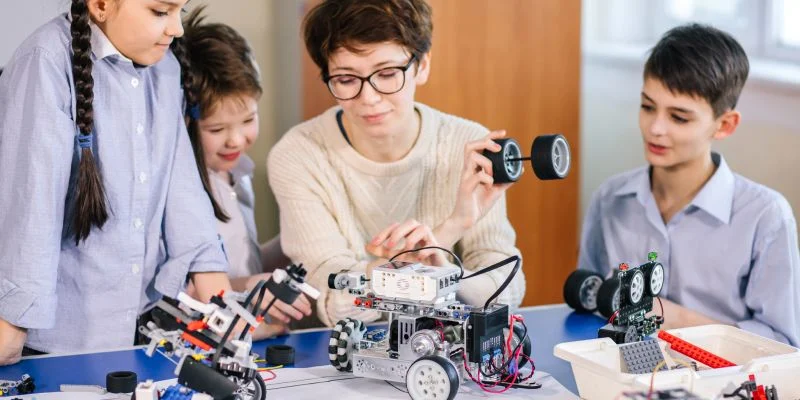
Robotics education for students involves designing, building, programming, and testing robots to understand how technology works. Instead of learning concepts only through textbooks, students can experiment with real-world challenges, observe results, identify mistakes, and improve their solutions.
From simple classroom robots to advanced programmable machines, robotics activities can support learners at different ages and ability levels. When integrated thoughtfully into the curriculum, robotics can encourage critical thinking, creativity, teamwork, and a deeper understanding of STEM subjects.
What Is Robotics Education?
Robotics education is a learning approach that uses robots and robotic systems to teach technical knowledge and transferable skills. Students explore how mechanical components, electronic systems, sensors, motors, and computer programs work together to complete tasks.
A robotics lesson may involve assembling a small robot, writing a program that controls its movements, or designing a machine that solves a specific problem. These activities connect classroom learning with practical applications.
Robotics education can include several important areas:
- Programming: Writing instructions that tell a robot what to do.
- Engineering: Designing, assembling, and improving mechanical systems.
- Electronics: Exploring circuits, sensors, motors, and other components.
- Mathematics: Applying measurement, geometry, logic, and calculations.
- Science: Investigating movement, energy, forces, and cause-and-effect relationships.
- Computational thinking: Breaking complex challenges into smaller, manageable steps.
These areas can be taught separately or combined through interdisciplinary projects. The most effective activities connect technical skills with clear learning objectives rather than focusing only on building a robot.
Why Is Robotics Education Important for Students?
Robotics helps students understand how technology can be used to solve practical problems. It also creates opportunities to apply knowledge from several subjects in a single learning experience.
1. Develops Critical Thinking and Problem-Solving Skills
Building and programming a robot requires students to make decisions, test ideas, and evaluate results. A robot may fail to follow a path, respond incorrectly to a sensor, or stop before reaching its destination.
Instead of treating these outcomes as simple failures, students can investigate what went wrong and develop a better solution.
For example, if a robot cannot navigate around an obstacle, learners may need to adjust its programming logic, sensor placement, or movement instructions. This process encourages them to analyze evidence, compare possible solutions, and make informed decisions.
Over time, these experiences can help students approach academic and everyday challenges with greater confidence.
2. Strengthens STEM Learning
Science, technology, engineering, and mathematics are closely connected in robotics. Students can see how mathematical calculations affect movement, how sensors collect information, and how engineering decisions influence a machine’s performance.
A classroom project involving a moving robot might require learners to measure distances, estimate travel time, calculate angles, and test different motor speeds.
These practical experiences can make abstract concepts easier to understand because students observe how ideas work outside a textbook.
Robotics can also help teachers introduce complex topics gradually, beginning with simple activities and progressing toward more challenging projects as students develop their skills.
3. Introduces Programming and Computational Thinking
Programming is an important component of many robotics projects. Students learn to provide instructions in a logical order, use conditions, repeat actions, and respond to information collected by sensors.
Beginners may start with visual programming blocks, while more advanced learners can explore text-based languages and more complex control systems.
Robotics encourages computational thinking through four key practices:
- Decomposition: Dividing a large task into smaller steps.
- Pattern recognition: Identifying similarities between problems and solutions.
- Abstraction: Focusing on the information necessary to solve a challenge.
- Algorithm design: Creating a clear sequence of instructions.
These skills are useful beyond robotics. They can support learning in mathematics, computer science, scientific investigation, and other subjects that require structured reasoning.
4. Encourages Creativity and Innovation
Robotics projects rarely have only one possible solution. Students can experiment with different designs, materials, programs, and strategies to achieve the same objective.
For example, a class might be asked to design a robot that transports small objects across a classroom. Some teams may prioritize speed, while others focus on stability, accuracy, or energy efficiency.
This freedom encourages students to explore their ideas and learn that creative thinking often involves testing multiple approaches.
Teachers can strengthen this benefit by allowing learners to make design choices instead of providing step-by-step instructions for every part of a project.
5. Improves Collaboration and Communication
Many robotics activities are more effective when students work in small teams. Each learner can contribute different strengths, such as programming, construction, testing, documentation, or presentation.
Working together requires students to explain their reasoning, listen to alternative ideas, divide responsibilities, and resolve disagreements.
For example, one student may identify a programming error while another notices that the robot’s wheels are not aligned correctly. Combining these observations can lead to a more effective solution.
Group projects also help learners practice giving constructive feedback and presenting technical information in a clear, organized way.
6. Builds Confidence and Resilience
Robotics naturally involves experimentation. Students may need several attempts before their robots behave as expected, giving them opportunities to practice persistence and adapt their strategies.
When learners identify a mistake and successfully improve their design, they can see the direct results of their effort.
Teachers can support this process by treating errors as useful information rather than reasons for embarrassment. Students should be encouraged to explain what they tried, what happened, and what they would change next.
This approach helps create a learning environment where curiosity and improvement matter more than getting every answer right on the first attempt.
Best Robotics Activities for Students
Robotics activities should match students’ ages, previous experience, available resources, and curriculum goals. Simple projects can introduce essential concepts, while more advanced challenges encourage independent design and programming.
1. Build a Basic Moving Robot
A moving robot is a practical starting point for beginners. Students assemble a simple model using a suitable educational robotics kit or other classroom components.
They can explore how motors, wheels, power sources, and control instructions work together.
Learning outcomes:
- Understand basic mechanical components.
- Follow assembly instructions.
- Recognize the relationship between power and movement.
- Practice testing and improving a design.
Teachers can extend the activity by asking students to make their robots travel a specific distance or complete a simple course.
2. Program a Robot to Follow a Line
In this activity, students program a robot to follow a dark line marked on a light surface. Depending on the equipment, the robot may use optical sensors to detect the line and adjust its movement.
Learners must understand how sensor readings influence the robot’s behavior. They can experiment with turning speed, sensor position, and programming conditions.
Learning outcomes:
- Understand inputs and outputs.
- Practice conditional programming.
- Explore feedback and automated control.
- Develop testing and debugging skills.
The activity can become more challenging by introducing curves, intersections, or multiple routes.
3. Design an Obstacle-Avoiding Robot
Students create a robot that detects objects and changes direction to avoid collisions. The robot may use distance sensors or other suitable detection methods.
Learners can compare different strategies, such as stopping before an obstacle, turning in a particular direction, or searching for an alternative path.
Learning outcomes:
- Explore sensors and environmental data.
- Apply decision-making logic.
- Understand basic automation.
- Evaluate the effectiveness of different algorithms.
This project can also introduce discussions about the limitations of automated systems and why testing is important before using them in real environments.
4. Create a Robotic Arm
A robotic arm introduces students to controlled movement, joints, gripping mechanisms, and mechanical design. Depending on the kit, learners may control the arm manually or program it to pick up and move lightweight objects.
Students can experiment with the position of joints, the shape of the gripper, and the sequence of movements.
Learning outcomes:
- Understand basic mechanical systems.
- Explore angles and spatial reasoning.
- Practice sequencing instructions.
- Investigate precision and design limitations.
Teachers can challenge teams to move objects between marked locations while minimizing errors.
5. Build a Smart Environmental Monitor
More advanced students can develop a small robotic or sensor-based project that collects information about environmental conditions. Depending on the equipment, the system might measure temperature, light intensity, or humidity.
Students can display the collected readings and discuss how the information could help people make decisions.
Learning outcomes:
- Understand sensors and data collection.
- Practice interpreting measurements.
- Connect engineering with environmental science.
- Explore how technology can address real-world problems.
Students should also discuss measurement accuracy, sensor limitations, and responsible use of collected data.
6. Design a Robot for a Classroom Challenge
Teachers can organize a team competition in which students design a robot to complete a defined task. The challenge might involve moving objects, navigating a maze, delivering a lightweight item, or reaching a target.
The objective should emphasize learning and improvement rather than speed alone.
Learning outcomes:
- Apply engineering design principles.
- Collaborate under shared constraints.
- Compare alternative solutions.
- Explain and evaluate design decisions.
After the challenge, teams can present their methods and discuss what they would improve in a second version.
How Robotics Supports Learning Across Different Subjects
One major advantage of robotics is its ability to connect concepts that are often taught separately. Teachers can design projects that reinforce existing lessons across the curriculum.
Robotics in Mathematics
Students can use robots to explore distance, speed, angles, coordinates, measurement, and geometric shapes.
For example, programming a robot to travel around a square requires learners to consider the length of each side and the angle of each turn. More advanced tasks can introduce ratios, estimation, and basic data analysis.
Robotics in Science
Robotics provides opportunities to investigate forces, motion, energy, electricity, and cause-and-effect relationships.
Students can test how changing a robot’s weight or motor speed affects its movement. They can record observations, compare results, and use evidence to explain what happened.
Robotics in Computer Science
Programming robots helps learners connect code with observable outcomes. They can practice sequences, loops, conditions, variables, and debugging in a practical setting.
Advanced activities may introduce more complex programming concepts, sensor integration, and basic autonomous behavior.
Robotics in Engineering and Design
Engineering activities require students to identify a problem, establish design requirements, develop possible solutions, construct a model, and test its performance.
Students learn that a successful design must satisfy its purpose while working within constraints such as time, materials, stability, and cost.
Robotics in Environmental Education
Students can investigate how sensors and automated systems are used in agriculture, energy management, waste sorting, and environmental monitoring.
These activities help learners connect technology with sustainability and discuss how engineering decisions affect people and the environment.
Robotics Education for Different Age Groups
The right robotics activities depend on students’ developmental stages, prior knowledge, and learning needs. Schools do not need to introduce advanced programming immediately.
Early Childhood and Kindergarten
Young children can explore simple cause-and-effect relationships through movement-based robots, guided play, and basic sequencing activities.
Teachers might ask learners to plan a route using directional cards or guide a simple robot toward a picture.
At this stage, the focus should be curiosity, spatial awareness, cooperation, and understanding instructions.
Elementary School Students
Elementary learners can begin assembling basic robots, using block-based programming, and completing structured challenges.
Activities might include navigating a maze, moving objects, or programming a robot to respond to a simple sensor.
Teachers should provide clear goals while allowing students enough freedom to experiment and explain their decisions.
Middle School Students
Middle school students can work on more complex projects involving sensors, loops, conditional statements, and engineering design.
They may build line-following robots, create obstacle-avoidance systems, or develop small machines that solve classroom problems.
Team-based challenges can help students integrate programming, mathematics, and design skills.
High School Students
High school learners can explore advanced programming, electronic components, mechanical systems, data analysis, and introductory autonomous robotics.
Projects may involve robotic arms, sensor networks, engineering prototypes, or automated systems designed for specific tasks.
Teachers can also introduce discussions about artificial intelligence, privacy, safety, accessibility, and the ethical responsibilities involved in developing technology.
How Teachers Can Introduce Robotics Into the Classroom
Successful robotics education requires more than purchasing equipment. Teachers need to connect activities with curriculum goals, provide appropriate support, and evaluate what students learn throughout the process.
1. Start With Clear Learning Objectives
Before selecting a project, determine what students should understand or be able to do by the end of the lesson.
An objective might focus on using conditional statements, measuring distance, explaining how a sensor works, or collaborating to solve a design problem.
Clear objectives help teachers choose activities that support meaningful learning rather than entertainment alone.
2. Choose Age-Appropriate Equipment
Schools can begin with simple programmable robots, classroom kits, reusable construction materials, or low-cost components.
The best choice depends on students’ experience, the learning objectives, teacher training, maintenance requirements, and available budgets.
It is also important to consider whether equipment can be reused across different lessons and whether students with varying abilities can participate.
3. Use Project-Based Learning
Project-based learning allows students to apply knowledge while working toward a meaningful outcome.
Rather than asking learners only to follow assembly instructions, teachers can present a problem and ask teams to design their own solutions.
For example, students might be challenged to create a robot that transports classroom materials safely. They would identify requirements, plan a design, build a prototype, test it, and explain their final choices.
4. Encourage Experimentation and Debugging
Robotics lessons should provide time for testing, troubleshooting, and improvement.
Teachers can ask students to document what happened during each test and explain how they changed their designs. This makes the learning process visible and encourages evidence-based reasoning.
When students encounter problems, teachers should offer guiding questions rather than immediately providing the solution.
5. Make Robotics Accessible to Every Student
Robotics should not be limited to learners who already excel in mathematics or programming. Activities can be designed with different entry points so that students with different skills and experience can contribute.
Useful approaches include assigning flexible team roles, offering visual instructions, providing alternative input methods where possible, and allowing different ways to demonstrate learning.
Teachers should also consider equipment costs, classroom space, language needs, and accessibility requirements when planning projects.
6. Assess Both the Process and the Final Product
A robot that successfully completes a task does not automatically demonstrate that every student understands the underlying concepts.
Teachers should evaluate the reasoning and learning process as well as the final result.
Assessment methods may include observation, programming exercises, design journals, short explanations, project demonstrations, and student reflections.
This approach helps teachers identify whether learners can explain their decisions and apply the skills to new challenges.
Learning Outcomes of Robotics Education
The outcomes of robotics education depend on the quality of instruction, the design of activities, available resources, and the support students receive.
When robotics is integrated thoughtfully into teaching, students may develop several types of knowledge and skills.
Technical Knowledge
Students can develop a basic understanding of programming, sensors, motors, mechanical components, and automated systems. More advanced learners may explore electronic circuits, data collection, and autonomous behavior.
Academic Understanding
Robotics activities can help students apply mathematical, scientific, and engineering concepts in practical situations. These connections may make it easier to discuss how classroom knowledge can be used to solve real problems.
Computational Thinking
Students practice organizing information, creating algorithms, recognizing patterns, and debugging programs. These habits can support problem-solving across several academic subjects.
Social and Communication Skills
Collaborative projects give students opportunities to share ideas, divide tasks, explain technical decisions, and resolve disagreements.
Motivation and Engagement
Hands-on activities can make lessons more interactive and give students visible evidence of their progress. However, engagement is strongest when the activity has a clear educational purpose and an appropriate level of challenge.
Research reviews generally report positive effects of educational robotics on learning, although outcomes vary by context, instructional approach, and comparison method. Robotics should therefore be treated as a teaching strategy that complements effective instruction, not as a guaranteed solution for every learning challenge.
Common Challenges in Robotics Education
Although robotics offers valuable learning opportunities, schools may face practical difficulties when introducing it.
Limited Budgets
Robotics kits, replacement parts, computers, and maintenance can create financial challenges. Schools can manage costs by starting with a small number of reusable kits, using simple projects, and organizing students into rotating groups.
Lack of Teacher Training
Teachers may need additional support to become comfortable with robotics hardware, programming, and troubleshooting.
Professional development, shared lesson plans, peer collaboration, and gradual project implementation can help build confidence.
Limited Classroom Time
Building and programming robots may require more time than a traditional lesson. Teachers can divide projects into shorter stages, prepare materials in advance, and establish clear milestones.
Unequal Student Participation
In group projects, one student may take control of the programming while others have fewer opportunities to contribute.
Rotating roles and requiring each student to explain part of the project can encourage balanced participation.
Technical Problems
Batteries, connections, sensors, and software may not work as expected. Teachers can prepare basic troubleshooting procedures and allow students to learn from technical problems instead of viewing them as wasted time.
Difficulty Measuring Learning
A successful robot demonstration may not reveal whether students understand the concepts involved.
Teachers should combine practical demonstrations with individual explanations, short assessments, observation, and reflection.
How to Measure the Success of Robotics Activities
Schools can evaluate robotics programs by measuring both technical achievement and broader learning outcomes.
Useful assessment methods include:
- Pre- and post-activity assessments: Compare students’ understanding before and after a project.
- Project rubrics: Evaluate design quality, programming logic, testing, and explanation.
- Observation checklists: Record collaboration, problem-solving, and participation.
- Student journals: Ask learners to document challenges, decisions, and improvements.
- Demonstrations: Have students show how their robots work and explain the underlying principles.
- Reflection questions: Encourage learners to identify what they learned and what they would change.
Assessment should focus on progress and understanding, not only on whether a robot completes a challenge. A student who identifies a programming error and explains how to correct it may demonstrate meaningful learning even if the final model is not perfect.
The Future of Robotics Education
As technology continues to develop, robotics education may increasingly connect with artificial intelligence, smart sensors, automation, and data-driven systems.
Students may use robots to explore how machines recognize patterns, respond to their surroundings, or perform repetitive tasks. These activities can introduce the capabilities and limitations of automated technology in an age-appropriate way.
Future robotics programs should also address responsible innovation. Students need opportunities to consider safety, accessibility, privacy, environmental impact, and the effects of automation on communities.
Schools do not need expensive laboratories to begin preparing learners for a technology-rich future. A well-planned project using simple equipment can introduce essential engineering principles and encourage students to ask meaningful questions about how technology works.
The priority should remain educational value: students should learn to understand, evaluate, design, and improve technology rather than simply operate it.
Frequently Asked Questions
What is robotics education for students?
Robotics education for students is a learning approach that uses robots and related technologies to teach programming, engineering, mathematics, science, and problem-solving. Students learn through designing, building, testing, and improving robotic systems.
What are the main benefits of robotics education?
The main benefits include stronger problem-solving skills, computational thinking, creativity, collaboration, technical knowledge, and practical STEM learning. The outcomes depend on the quality of activities and the support provided by teachers.
At what age can students start learning robotics?
Students can begin exploring basic robotics in early childhood through simple movement and sequencing activities. As they grow, they can progress to block-based programming, sensors, mechanical design, and more advanced coding.
Do students need programming experience to learn robotics?
No. Beginners can start with simple construction activities and visual programming tools. Teachers can introduce more advanced programming concepts as students develop their confidence and understanding.
What are some easy robotics projects for beginners?
Beginner-friendly projects include building a moving robot, programming a robot to follow a line, creating an obstacle-avoidance system, and designing a simple robotic arm. The best activity depends on students’ ages, equipment, and learning objectives.
How does robotics support STEM education?
Robotics connects science, technology, engineering, and mathematics through practical challenges. Students can apply concepts such as measurement, motion, programming logic, and design while observing the results of their decisions.
How can schools assess robotics learning outcomes?
Schools can use project rubrics, practical demonstrations, individual explanations, observation checklists, student journals, and pre- and post-activity assessments. These methods help evaluate both technical knowledge and the learning process.
Is robotics education expensive?
Costs vary according to the equipment and project complexity. Schools can begin with a small number of reusable educational kits, simple materials, and shared classroom resources before investing in more advanced systems.
Conclusion
Robotics education offers students a practical way to explore technology, develop STEM knowledge, and learn how to solve problems through experimentation. By building and programming robots, learners can connect classroom concepts with real-world applications while practicing creativity, communication, collaboration, and logical thinking.
Effective robotics education does not depend entirely on advanced equipment or complicated projects. It depends on clear learning objectives, age-appropriate activities, supportive teaching, and meaningful opportunities for students to test their ideas.
For schools seeking to strengthen modern learning, robotics can provide a flexible and engaging approach to developing technical understanding and transferable skills. With thoughtful planning and inclusive classroom practices, robotics education can help students become more confident problem-solvers and better-prepared participants in an increasingly technology-driven world.
