
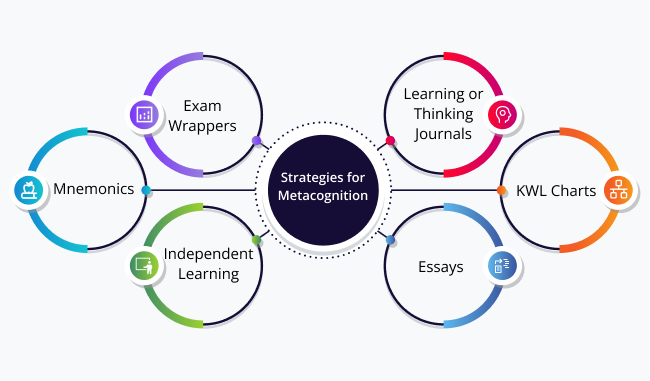
Successful learning involves more than memorizing facts, completing assignments, or preparing for examinations. Students also need to understand how they learn, recognize when they are confused, choose appropriate study methods, and evaluate whether their efforts are producing results. These abilities help learners become more confident, organized, and independent.
This is where metacognition becomes important. Metacognition is the process of thinking about one’s own thinking. It allows students to recognize what they know, identify what they still need to learn, and make informed decisions about how to improve.
Using effective metacognition strategies for students can strengthen problem-solving, encourage self-reflection, and help learners take greater responsibility for their education. Instead of depending entirely on teachers or parents for direction, students gradually learn to plan their work, monitor their understanding, and evaluate their progress.
For teachers, parents, and educational institutions, developing metacognitive skills is an important way to support lifelong learning and academic independence.
What Is Metacognition in Education?
Metacognition refers to a learner’s awareness of their own mental processes and their ability to regulate those processes. In education, it helps students understand how they approach a task, which strategies are effective, and when they need to change their approach.
For example, imagine a student preparing for a science examination. One approach is to read the textbook repeatedly and assume the material has been learned. A metacognitive learner takes a more active approach by asking questions such as:
- Which concepts do I understand well?
- Which topics are still confusing?
- Can I explain this process without looking at my notes?
- Which study method will help me remember the information?
- How can I check whether I am ready for the examination?
These questions encourage students to examine their learning rather than simply spend time studying.
Metacognition is closely connected to self-regulated learning, which involves managing one’s learning goals, strategies, effort, and progress. Both concepts help students become more independent by giving them practical ways to make decisions about their education.
The Two Main Components of Metacognition
Metacognition generally involves two related components: metacognitive knowledge and metacognitive regulation. Understanding both helps teachers develop activities that support independent learning.
1. Metacognitive Knowledge
Metacognitive knowledge is an understanding of how learning works and how different strategies can be used.
It includes awareness of personal strengths, the demands of a task, and the strategies available to complete it successfully.
For example, a student may recognize that diagrams help with understanding biology, while solving practice problems is more useful for learning mathematics. Another student may understand that writing a short outline before an essay helps organize ideas.
Metacognitive knowledge also includes understanding that different tasks require different approaches. Memorizing vocabulary, interpreting a poem, and solving a complex mathematical problem do not always benefit from the same study technique.
Students develop this knowledge by trying different methods, receiving feedback, reflecting on their results, and learning why particular strategies work.
2. Metacognitive Regulation
Metacognitive regulation involves controlling and adjusting the learning process. It includes planning before beginning a task, monitoring understanding during the task, and evaluating the results afterward.
A student who plans a revision schedule, checks their answers while solving problems, and changes their study method after discovering weaknesses is using metacognitive regulation.
These skills help learners respond to difficulties instead of continuing with an ineffective approach.
Metacognitive regulation is particularly valuable when students face unfamiliar tasks because they may not have a teacher immediately available to guide every decision.
Why Metacognition Matters for Independent Learning
Independent learners can take responsibility for their progress while recognizing when they need guidance. They do not have to work alone at all times; rather, they can make thoughtful decisions about when to seek help and how to use feedback.
Metacognition supports this independence in several ways.
It Encourages Self-Awareness
Students do not always know whether they truly understand a topic. They may feel confident after reading a chapter but struggle when asked to explain it without assistance.
Metacognitive reflection helps students compare their confidence with their actual performance.
For example, a student might rate their understanding of a topic before completing a practice quiz. After reviewing the results, they can identify whether their confidence was accurate and which concepts need more attention.
This awareness helps learners make better decisions about where to focus their time.
It Improves Study Decisions
Students often develop study habits through trial and error. Some methods may be helpful for particular subjects but less effective for others.
Metacognition encourages learners to evaluate the results of their choices.
A student who discovers that rereading notes does not prepare them adequately for application-based questions can try self-testing, practice problems, or explaining concepts in their own words.
Over time, students become better at selecting strategies that match their learning goals.
It Supports Problem-Solving
When students encounter a difficult problem, they may immediately assume they cannot solve it. Metacognitive strategies encourage them to pause, examine the problem, and consider alternative approaches.
They can identify what the question requires, determine which information is relevant, select a strategy, and check whether the answer makes sense.
This approach is useful in mathematics, science, writing, research, and everyday decision-making.
It Builds Academic Confidence
Confidence grows when students understand how to respond to challenges and recognize their own progress.
Metacognition helps learners see that difficulties can often be addressed through a change in strategy, additional practice, or a clearer explanation.
Rather than interpreting every mistake as failure, students can treat errors as information that guides improvement.
This can encourage persistence and a more constructive attitude toward learning.
It Develops Lifelong Learning Skills
Learning does not stop when students leave school. Adults regularly need to acquire new skills, understand unfamiliar information, and adapt to changing professional and personal demands.
Metacognitive abilities help individuals recognize knowledge gaps, identify learning resources, monitor their progress, and adjust their methods.
Teaching these skills during school can prepare students to approach future learning with greater independence and flexibility.
The Three Stages of Metacognitive Learning
A practical way to teach metacognition is to organize it into three stages: planning, monitoring, and evaluation. Students can use this cycle before, during, and after almost any learning activity.
Stage 1: Planning Before Learning
Planning helps students understand the task and decide how to approach it before they begin.
At this stage, learners identify the goal, estimate the time required, consider what they already know, and select suitable strategies.
For example, a student preparing a research assignment might divide the work into understanding the question, gathering information, organizing ideas, drafting, and reviewing.
A student preparing for a mathematics test might identify the topics covered, review previous mistakes, and schedule practice sessions for the most difficult concepts.
Teachers can support planning by asking students:
- What do I need to learn or complete?
- What do I already know about this topic?
- Which part is likely to be most challenging?
- What resources or strategies will I need?
- How will I know when I have completed the task successfully?
These questions encourage students to approach assignments with purpose rather than beginning without a clear plan.
Stage 2: Monitoring During Learning
Monitoring involves checking understanding and progress while completing a task.
Students need to notice when they are confused, losing focus, making repeated mistakes, or using a strategy that is not working.
For example, while reading a difficult passage, a student might pause after each section and summarize the main idea. If the summary is unclear, the student can reread the passage, examine unfamiliar vocabulary, or ask for clarification.
During mathematics practice, learners can check each step of a solution instead of waiting until the entire assignment is finished.
Teachers can encourage monitoring by asking:
- Do I understand what I am doing?
- Can I explain this idea in my own words?
- Is my current strategy helping me?
- Have I made an error that I need to correct?
- Should I try a different approach?
Regular monitoring helps students address misunderstandings before they become larger obstacles.
Stage 3: Evaluating After Learning
Evaluation occurs after students finish an activity, lesson, or assignment. It involves reviewing the outcome and deciding what to improve next time.
Students can compare their performance with the original goal, examine mistakes, and reflect on which strategies were effective.
For example, after receiving feedback on an essay, a student might recognize that the argument was clear but the evidence was weak. The next writing assignment can then include a specific goal to improve the use of supporting evidence.
Useful evaluation questions include:
- Did I achieve my learning goal?
- Which parts did I understand well?
- Where did I struggle?
- Which strategy helped me most?
- What will I do differently next time?
Evaluation makes learning a continuous process. Each task provides information that can improve the next one.
Effective Metacognition Strategies for Students
Students can develop metacognitive skills through simple, repeatable habits. These strategies work best when teachers explain their purpose and help students practice them regularly.
1. Set Clear Learning Goals
Clear goals give students a direction and a way to measure progress.
Instead of setting a broad goal such as “study science,” a student might aim to explain the stages of a particular process, answer ten practice questions accurately, or summarize a chapter without using notes.
Specific goals help students identify what they need to accomplish and evaluate whether their work was successful.
Goals should be realistic and challenging enough to encourage improvement without becoming overwhelming.
2. Use a Learning Journal
A learning journal gives students a place to record their goals, difficulties, strategies, and progress.
After a lesson or study session, students can write a few sentences about what they learned, what confused them, and what they plan to do next.
For example:
- What I learned: I can solve equations with one variable.
- What I found difficult: I sometimes make mistakes when moving terms between sides.
- What helped: Writing each step separately made the process clearer.
- My next goal: Practice similar problems and check each step carefully.
The purpose is not to produce a long diary entry. Short, focused reflections can help students recognize patterns in their learning and make better decisions.
3. Practice Self-Questioning
Self-questioning encourages students to actively examine their understanding instead of assuming that familiar information has been mastered.
Students can ask questions before, during, and after a task.
Before studying, they might ask what they already know. During a task, they can check whether they understand each step. Afterward, they can explain the main ideas from memory.
For reading assignments, students might ask what the author is trying to explain, which evidence supports the main idea, and whether they can summarize the passage accurately.
For problem-solving tasks, they can ask why a particular method is appropriate and whether another method might work.
These questions help learners identify gaps in understanding and become more deliberate in their thinking.
4. Use Self-Testing to Check Understanding
Self-testing allows students to compare what they think they know with what they can actually recall or apply.
Rather than relying only on rereading, learners can answer practice questions, use flashcards, solve problems without examples, or explain concepts from memory.
After completing the test, they should review incorrect answers and identify why they made those mistakes.
For example, a student may discover that they remember scientific definitions but cannot apply them to unfamiliar situations. This indicates that their next study session should include application questions rather than additional definition memorization.
Self-testing therefore serves two purposes: it strengthens learning and helps students decide what to study next.
5. Break Large Tasks Into Smaller Steps
Complex assignments can feel difficult when students try to manage everything at once.
Breaking a task into smaller steps makes it easier to plan, monitor, and evaluate progress.
A long essay might be divided into understanding the prompt, creating an outline, drafting the introduction, developing supporting paragraphs, revising the argument, and checking grammar.
Students can review their progress after completing each step and adjust their plans when necessary.
This strategy also makes it easier to identify exactly where a problem occurs. If an essay lacks a clear argument, the student can focus on planning and organization instead of rewriting every sentence.
6. Explain Concepts in Your Own Words
Explaining a concept in simple language helps students determine whether they understand it beyond memorizing the wording in a textbook.
A learner might explain a scientific process to a classmate, summarize a historical event aloud, or describe how a mathematical formula works.
If the explanation becomes unclear or relies heavily on copying definitions, the student can identify which parts require further study.
This strategy can also reveal missing connections between ideas.
Teachers can encourage students to explain not only what an answer is but also why it is correct and how they reached it.
7. Analyze Mistakes Instead of Ignoring Them
Mistakes provide useful information about a student’s understanding, but only when learners examine them carefully.
Students can maintain an error log that records the question, the incorrect response, the reason for the mistake, and the correct approach.
Mistakes may result from misunderstanding a concept, overlooking instructions, choosing an unsuitable strategy, or rushing through a task.
Identifying the cause helps students select a relevant solution.
For instance, a student who repeatedly misreads word problems may benefit from underlining important information and rewriting the question in their own words. A student who understands the method but makes arithmetic errors may need to slow down and check calculations.
8. Reflect on Which Study Strategies Work Best
Different learning tasks require different approaches. Students can improve their study decisions by comparing strategies and observing their results.
A student might use practice questions to prepare for a science examination, diagrams to understand a biological system, and outlines to organize an essay.
Afterward, they can consider which method helped them understand and remember the material.
The goal is not to label one strategy as universally best. Instead, students learn to select methods according to the subject, task, and desired outcome.
9. Use Peer Discussion and Teaching
Explaining an idea to another student can reveal gaps in understanding and introduce alternative ways of thinking.
During a study group, students can take turns explaining a concept, asking questions, and discussing different solutions.
The student explaining the material must organize their thoughts, while the listener can identify unclear points and request further explanation.
Teachers should encourage respectful discussion and ensure that students check explanations for accuracy. Peer teaching works best when learners remain responsible for verifying information rather than simply accepting every explanation.
10. Create a Personal Improvement Plan
A personal improvement plan helps students turn reflection into action.
After reviewing their work, learners can identify one or two areas for improvement, choose specific strategies, and set a date to review their progress.
For example, a student who struggles with time management might estimate how long assignments will take, use a weekly schedule, and record whether tasks are completed on time.
At the end of the week, the student can evaluate which changes helped and what needs adjustment.
This process encourages responsibility and helps learners see improvement as the result of informed decisions and consistent effort.
How Teachers Can Develop Metacognitive Skills in the Classroom
Metacognition is not always something students develop automatically. Many learners benefit from explicit instruction, demonstrations, and regular opportunities to reflect on their thinking.
Teachers can make metacognition part of everyday instruction rather than treating it as a separate subject.
Model Thinking Aloud
Teachers can demonstrate how experienced learners approach a challenging task by explaining their decisions aloud.
While solving a mathematics problem, a teacher might describe how they identify the relevant information, choose a method, check each step, and reconsider the approach when the answer seems incorrect.
This process makes otherwise hidden thinking visible to students.
After observing the demonstration, students can practice the same process with guided questions before gradually taking responsibility for their own decisions.
Use Metacognitive Prompts
Short prompts remind students to pause and consider their learning.
Examples include:
- What is the main goal of this task?
- What strategy will I use first?
- How can I check my understanding?
- What should I do if I become stuck?
- What did I learn from this activity?
Prompts can appear on worksheets, classroom displays, assignment instructions, or reflection sheets.
They should be connected to the specific task and used consistently. As students become more confident, teachers can gradually reduce the prompts so learners can apply the process independently.
Build Reflection Into Lessons
Teachers can reserve a few minutes at the end of a lesson for students to review what they learned and identify remaining questions.
A short exit ticket might ask students to explain one important concept, identify one area of uncertainty, and state what they will do to address it.
These responses help teachers understand student thinking while encouraging learners to monitor their own progress.
Reflection is most useful when students use it to guide future action rather than simply complete a form.
Provide Feedback That Encourages Thinking
Feedback should help students understand not only whether an answer is correct but also how to improve their approach.
Teachers can ask students to explain their reasoning, compare alternative solutions, and identify the step where their understanding became unclear.
This encourages learners to take an active role in correcting errors.
Specific feedback is generally more useful than vague comments because it gives students a clear next step.
Gradually Transfer Responsibility to Students
At first, teachers may need to guide students through every stage of planning, monitoring, and evaluation. Over time, they can reduce the amount of support provided.
For example, younger learners might use a checklist with questions about task completion and understanding. Older students might design their own revision plans, choose practice methods, and evaluate their examination preparation.
The aim is to help students move from supported practice toward independent decision-making while keeping appropriate help available when needed.
Metacognition Across Different School Subjects
Metacognitive skills are useful across the curriculum, but their application should reflect the demands of each subject.
Metacognition in Mathematics
Students can plan which method to use, monitor their calculations, and evaluate whether the final answer is reasonable.
After solving a problem, they can explain why the chosen method worked and consider whether another approach would be more efficient.
When an answer is incorrect, reviewing each step helps identify whether the difficulty came from understanding the concept, selecting a strategy, or carrying out the calculation.
Metacognition in Reading and Writing
Readers can pause to summarize passages, identify confusing sections, and check whether the author’s main argument is clear.
Writers can plan the purpose of an essay, monitor whether each paragraph supports the central argument, and revise their work after reviewing feedback.
For example, a student might discover that an essay includes relevant facts but does not explain how those facts support the main claim. Recognizing this problem allows the student to focus on reasoning and organization during revision.
Metacognition in Science
Science students can identify what they expect an experiment to demonstrate, monitor whether observations match their predictions, and evaluate how well the evidence supports a conclusion.
They can also distinguish between what they observed and what they inferred.
After an experiment, students might ask whether the procedure was appropriate, whether other explanations are possible, and what they would change if they repeated the investigation.
This approach supports scientific reasoning and careful evaluation of evidence.
Metacognition in History and Social Studies
Students can examine how evidence supports historical interpretations, compare sources, and recognize when they need more information.
While studying an event, they can distinguish between key facts, different perspectives, and their own assumptions.
After completing an assignment, they can evaluate whether their conclusions are supported by evidence and whether alternative explanations should be considered.
Metacognition in Digital Learning
Online learning often requires students to manage their own time, choose appropriate resources, and monitor progress with less immediate supervision.
Students can set daily learning goals, check their understanding through practice activities, record questions, and schedule time for reviewing difficult topics.
They should also evaluate the reliability of digital information and recognize when an online explanation is incomplete or inaccurate.
These habits help learners use educational technology more thoughtfully and responsibly.
Common Challenges When Teaching Metacognition
Although metacognition can support learning, students may find it difficult to use these strategies consistently at first.
Students May Overestimate Their Understanding
Learners sometimes mistake familiarity for mastery. Reading the same material repeatedly may feel comfortable even when they cannot explain it independently.
Teachers can address this by combining confidence ratings with practice questions, explanations, and other observable demonstrations of understanding.
Reflection Can Become Superficial
If students are asked to reflect without clear guidance, they may provide vague responses such as “I did well” or “I need to study more.”
Teachers can encourage deeper reflection by asking students to identify specific evidence, describe the strategy they used, and name one practical next step.
Students May Find Planning Difficult
Some learners struggle to estimate how long a task will take or determine which steps are necessary.
Teachers can model planning, provide examples, and use simple checklists before expecting students to create their own plans.
Students May Resist Changing Familiar Habits
Learners sometimes continue using a comfortable study method even when it produces weak results.
Rather than simply telling them to change, teachers can compare the outcomes of different strategies and help students evaluate which methods best match their goals.
Reflection Takes Time
Teachers may feel pressure to cover curriculum content quickly. However, brief reflection activities can help identify misunderstandings and make future instruction more effective.
The goal is not to add lengthy reflection exercises to every lesson. Short, purposeful prompts integrated into existing activities can provide meaningful practice.
How Parents Can Encourage Metacognition at Home
Parents and caregivers can help children develop metacognitive habits by encouraging them to think about their learning rather than immediately providing every answer.
When a child struggles with homework, a parent might ask, “What have you tried so far?” or “Which part is confusing?” These questions encourage the child to identify the problem and consider possible solutions.
Parents can also help children establish realistic goals, review completed assignments, and reflect on what they would do differently next time.
Useful questions include:
- What was the most important thing you learned today?
- Which part was easiest or most difficult?
- How did you solve that problem?
- What could you try if you get stuck again?
- What will you practice next?
It is important to keep these conversations supportive rather than turning them into constant tests. Children should feel comfortable admitting that they do not understand something.
Parents can also model metacognition by explaining their own problem-solving process. For example, when learning a new skill, an adult can describe what they found difficult, which method helped, and how they checked their progress.
These everyday conversations show children that effective learning involves reflection, adjustment, and persistence.
A Simple Weekly Metacognition Routine for Students
Students can begin developing metacognitive skills through a short routine that fits into their existing study schedule.
| Stage | Student activity | Purpose |
|---|---|---|
| Before studying | Set one clear learning goal | Establish direction |
| At the beginning | Identify what is already known | Connect prior knowledge |
| During study | Pause to check understanding | Detect confusion early |
| After practice | Review answers and mistakes | Identify areas for improvement |
| At the end | Write a short reflection | Evaluate the strategy |
| Next session | Adjust the plan based on results | Improve independent learning |
For example, a student preparing for a history test might begin by setting a goal to explain three major events. During revision, the student could summarize each event without notes and check the accuracy of the explanation.
Afterward, the student might discover that the sequence of events is clear but the causes are confusing. The next study session can focus specifically on cause-and-effect relationships.
This simple cycle turns study time into a process of continuous improvement.
How to Measure Progress in Metacognitive Learning
Metacognitive development is not measured only by examination scores. Teachers can also look for changes in how students plan, monitor, and evaluate their work.
Evidence of progress may include students setting more realistic goals, selecting appropriate study methods, identifying confusion earlier, explaining their reasoning, and making useful adjustments after feedback.
Teachers can use reflection journals, observation, student conferences, task checklists, and examples of completed work to monitor development.
Students can also compare earlier and later assignments to see whether they are becoming more independent and making fewer repeated mistakes.
It is important to recognize that metacognitive growth takes time. Students may need different levels of support depending on their age, prior knowledge, task complexity, and learning needs.
The purpose of assessment should be to identify helpful next steps rather than expect every student to demonstrate the same level of independence immediately.
Frequently Asked Questions
1. What are metacognition strategies for students?
Metacognition strategies for students are methods that help learners plan, monitor, and evaluate their own learning. Examples include setting goals, self-questioning, self-testing, keeping learning journals, analyzing mistakes, and reflecting on which study methods are effective.
2. How does metacognition help students become independent learners?
Metacognition helps students recognize what they know, identify what they need to improve, and choose appropriate strategies. These skills allow learners to make more informed decisions, solve problems more independently, and seek help when necessary.
3. What is the difference between metacognition and self-regulated learning?
Metacognition involves awareness and regulation of thinking, including knowledge about learning strategies and monitoring understanding. Self-regulated learning is broader and includes managing goals, motivation, behavior, time, and learning activities. The two concepts overlap and often work together.
4. Can metacognition improve academic performance?
Research suggests that explicit instruction in metacognitive and learning strategies can support academic performance. The results depend on how strategies are taught, how consistently students use them, and whether instruction is connected to meaningful subject-specific tasks.
5. How can teachers teach metacognition in the classroom?
Teachers can model their thinking aloud, ask students to explain their reasoning, provide planning and reflection prompts, encourage self-testing, and build short reflection activities into lessons. Gradually reducing support helps students apply these strategies more independently.
6. At what age should students begin learning metacognitive strategies?
Children can begin developing basic metacognitive habits during early schooling. Younger students may use simple questions and visual checklists, while older students can create study plans, evaluate strategies, and reflect more independently. Activities should match students’ developmental levels.
7. How can students practice metacognition at home?
Students can set study goals, check their understanding without notes, record mistakes, explain concepts in their own words, and review what helped them learn. A short reflection at the end of each study session can help them decide what to do next.
8. Why is reflection important for independent learning?
Reflection helps students identify what worked, recognize difficulties, and decide how to improve future performance. Without reflection, learners may repeat ineffective habits without understanding why they are struggling.
Conclusion
Metacognition helps students become independent learners by teaching them how to understand, manage, and improve their own learning processes. Through planning, monitoring, and evaluation, students learn to set meaningful goals, recognize misunderstandings, select appropriate strategies, and respond constructively to mistakes.
Practical strategies such as self-questioning, learning journals, self-testing, peer discussion, and error analysis can make these skills part of everyday learning. Teachers can strengthen them through explicit instruction and guided practice, while parents can encourage reflection and problem-solving at home.
The most effective approach is to make metacognition a regular part of learning rather than an occasional activity. When students consistently reflect on their progress and adjust their methods, they can develop greater independence, stronger learning habits, and the confidence to approach unfamiliar challenges throughout their education and beyond.
