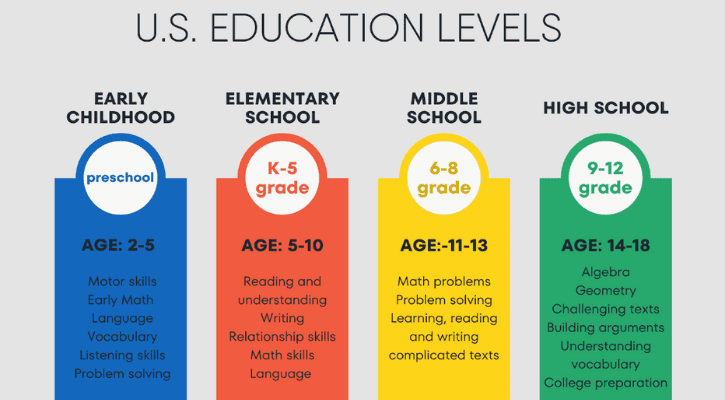
The education system in the United States is one of the largest and most diverse in the world. It includes public and private schools, colleges, universities, community colleges, vocational institutions, and specialized training programs. Although the overall structure is similar across the country, education policies can vary from one state and school district to another.
For international students and families, understanding how the U.S. education system works can make it easier to choose the right school, plan an academic journey, and understand the different qualifications available.
Early Childhood Education
Education in the United States can begin before children enter formal school. Preschool and early childhood education programs are available for young children, although participation and requirements vary by state and community.
Kindergarten generally serves children around five years old and is often the first formal year of a child’s school experience. In many areas, kindergarten is followed by elementary school.
Elementary School
Elementary education typically covers several years of a child’s early academic development. Students commonly study subjects such as:
- English and reading
- Mathematics
- Science
- Social studies
- Art
- Physical education
Schools may also provide technology, music, foreign-language instruction, and other subjects depending on the district.
The goal during these years is to build fundamental academic skills while helping students develop communication, problem-solving, and social skills.
Middle School
After elementary school, students usually move into middle school or junior high school. This stage commonly includes grades six through eight, although the exact structure differs between school districts.
Students begin taking classes with different teachers for individual subjects. Academic work also becomes more specialized, with subjects such as biology, history, literature, mathematics, and technology becoming more detailed.
Middle school is also an important period for students to explore extracurricular activities, sports, arts, and personal interests.
High School
High school generally includes grades nine through twelve. Students work toward a high school diploma, which is an important qualification for entering college, university, vocational training, or the workforce.
In addition to required subjects, high schools often allow students to choose elective courses. These can include computer science, business, foreign languages, journalism, engineering, art, music, and career-focused subjects.
Some students can also take advanced courses such as Advanced Placement (AP), International Baccalaureate (IB), or honors classes. These programs can provide more challenging academic work and, depending on the program and institution, opportunities for college-level credit.
Higher Education
After completing high school, students can continue their education at a college, university, community college, or other postsecondary institution.
Community colleges commonly offer two-year associate degree programs and career-oriented training. Many students also use community colleges as a pathway toward a bachelor’s degree.
Universities and four-year colleges generally offer bachelor’s degree programs. Students may choose a major, which represents their primary field of study, while also completing general education and elective courses.
Examples of common areas of study include business, engineering, computer science, healthcare, education, communications, and social sciences.
Graduate Education
Students who complete a bachelor’s degree may continue to graduate school. Graduate education includes master’s degrees, doctoral programs, and various professional degrees.
A master’s degree usually involves advanced study in a specific academic or professional field. Doctoral programs are generally focused on advanced research and scholarship.
Professional education is also available in areas such as law, medicine, dentistry, and other specialized professions.
Public and Private Education
The U.S. education system includes both public and private institutions.
Public schools are generally funded through a combination of federal, state, and local sources. Public colleges and universities may also receive government support and often have different tuition structures for in-state and out-of-state students.
Private schools and universities are independently operated and may have different tuition costs, admission requirements, academic programs, and financial-aid policies.
Education for International Students
The United States is also a major destination for international students. Students from around the world attend American high schools, colleges, universities, language programs, and other educational institutions.
International students should carefully review admission requirements before applying. Depending on the institution and program, requirements may include academic records, English-language proficiency, standardized tests, financial documentation, and other application materials.
Students should also research tuition, accommodation, health insurance, scholarships, and visa requirements when planning to study in the United States.
The Role of State and Local Governments
One important feature of American education is that there is no single national school system that controls every school. States and local school districts have significant responsibility for education.
As a result, curriculum requirements, graduation rules, school calendars, testing policies, and other details can vary considerably from one state to another.
This flexibility allows communities to design programs around local needs, but it also means that students and parents should check the specific requirements of their state, school district, or institution.
Choosing the Right Educational Path
The U.S. education system provides many possible paths. A student interested in a traditional academic career may choose a four-year university, while someone seeking practical skills may prefer a community college or vocational program.
International students may also compare universities based on factors such as academic programs, tuition, location, campus facilities, student support, scholarships, and career opportunities.
Rather than choosing an institution based only on its reputation, students should consider whether the program matches their academic goals, budget, interests, and long-term plans.
Final Thoughts
The U.S. education system offers a wide range of opportunities, from early childhood education and public schools to community colleges, universities, and advanced graduate programs. Its decentralized structure means that specific rules and programs can differ by state and institution.
For students considering education in the United States, researching individual schools and understanding their admission, financial, and academic requirements is an important first step. With careful planning, students can identify an educational pathway that fits their goals and prepares them for future academic or professional opportunities.
Leave a Reply