
Introduction
Education is most effective when students can do more than memorize information. They should be able to understand concepts, apply their knowledge, solve problems, and demonstrate the skills they need in real-life situations. However, students learn at different speeds, have different strengths, and often need different levels of support to achieve the same learning goals.
Competency-based education (CBE) addresses these differences by focusing on what learners know and can demonstrate rather than relying only on time spent in a classroom or completion of assignments. It establishes clear learning expectations and allows students to develop their skills through practice, feedback, and meaningful assessments.
For educators, parents, and students looking for competency based education explained in simple terms, the central idea is straightforward: students should demonstrate that they have mastered essential knowledge and skills before moving to more advanced learning.
This approach can be used in elementary and secondary schools, colleges, universities, professional training, and online learning programs. When thoughtfully implemented, it can make education more personalized, practical, and focused on measurable learning outcomes.
What Is Competency-Based Education?
Competency-based education is an instructional approach in which learning objectives are defined as specific competencies that students must demonstrate. A competency combines relevant knowledge, practical skills, and the ability to apply learning in an appropriate context.
Instead of measuring achievement only through attendance, time spent studying, or traditional examinations, competency-based systems evaluate whether students can demonstrate the required level of proficiency.
For example, a mathematics student might be expected to solve multi-step problems, explain the reasoning behind a solution, and apply mathematical concepts to everyday situations. Simply completing a chapter would not necessarily demonstrate mastery. The student must show that they can use the knowledge effectively.
Similarly, a student learning academic writing might need to develop a clear argument, organize evidence, support claims, and revise a draft using feedback. These measurable abilities provide a clearer picture of what the student has learned.
Competency-based education does not eliminate academic content or structured instruction. Instead, it organizes teaching, practice, and assessment around clearly defined learning outcomes.
Key Principles of Competency-Based Education
Successful competency-based education programs share several important principles. Schools may implement them differently, but the following features provide a useful foundation.
1. Clearly Defined Learning Outcomes
Students need to understand what they are expected to learn and how their progress will be evaluated. Competencies should therefore be specific, measurable, and connected to meaningful educational goals.
A vague objective such as understanding science is difficult to assess. A more specific competency might require students to design a simple investigation, identify variables, record observations, and explain their conclusions using evidence.
Clear outcomes help teachers plan lessons and allow students to monitor their own progress.
2. Progress Based on Demonstrated Mastery
In a competency-based model, students progress when they demonstrate the required knowledge and skills. They may receive additional practice or instruction when they have not yet reached the expected level.
This approach recognizes that learners do not always master a concept at the same time. One student may understand fractions quickly, while another needs visual models, guided examples, and additional exercises.
The learning expectations remain consistent, but the support and time required to achieve them can vary.
3. Personalized Learning and Support
Students bring different experiences, abilities, interests, and learning needs to the classroom. Competency-based education encourages teachers to respond to these differences without lowering essential learning expectations.
Teachers can provide small-group instruction, individual conferences, practice activities, visual explanations, or enrichment tasks. Students who need more help receive targeted support, while those who demonstrate mastery can explore more challenging applications.
Personalized learning helps make instruction more responsive to individual progress.
4. Meaningful Assessment and Feedback
Assessment is an ongoing part of competency-based education rather than an event that happens only at the end of a unit.
Teachers use quizzes, projects, presentations, demonstrations, written explanations, and other forms of evidence to determine whether students have mastered a competency. Feedback identifies what students are doing well, what needs improvement, and what they should do next.
Students may also review their own work against clear criteria. This encourages reflection, responsibility, and a better understanding of the learning process.
5. Application of Knowledge in Real Situations
Knowing a definition is different from using that knowledge to solve a problem. Competency-based education emphasizes applying concepts in relevant situations.
For example, students learning financial mathematics might prepare a budget, compare prices, calculate discounts, and explain how they would make spending decisions. These activities connect academic knowledge with practical life skills.
Real-world applications also help students understand why a topic matters and how different subjects connect.
How Competency-Based Education Works in Practice
Although individual programs vary, implementing competency-based education generally involves a sequence of connected steps.
Step 1: Identify the Essential Competencies
Teachers begin by deciding what students should know and be able to do by the end of a lesson, unit, course, or program.
These competencies should align with curriculum standards and the broader educational goals of the institution. They should also be realistic for the learners’ level and appropriate to the subject.
For example, a language arts competency might require students to write a well-organized explanatory essay supported by relevant evidence.
Step 2: Establish Clear Success Criteria
Each competency needs criteria that explain what successful performance looks like. A rubric can help students and teachers evaluate the quality of the work consistently.
For an essay, the criteria might include organization, clarity, evidence, grammar, and the strength of the explanation. Sharing these expectations before students begin helps them understand the purpose of the task.
Step 3: Teach, Model, and Provide Practice
Teachers introduce the necessary knowledge and skills through explanations, demonstrations, discussions, examples, and guided activities.
Students then practice applying what they have learned. Teachers may adjust instruction based on classroom observations, questions, and early assessment results.
The objective is not simply to cover content but to create opportunities for students to develop the required competencies.
Step 4: Assess Student Performance
Students demonstrate their learning through an appropriate assessment. Depending on the competency, this might involve solving problems, conducting an experiment, writing a report, presenting an argument, or completing a practical task.
The assessment should measure the intended competency directly. A test that asks students to recall facts, for example, may not be enough to establish whether they can apply those facts in a complex situation.
Step 5: Provide Feedback and Additional Support
When students have not yet demonstrated mastery, teachers identify the specific areas requiring improvement. Students may receive further explanations, alternative examples, guided practice, or targeted assignments.
When students meet the expected standard, they can move forward or apply the competency to more advanced tasks.
This process creates a continuous cycle of learning, assessment, feedback, and improvement.
Practical Applications of Competency-Based Education
Competency-based education can be adapted to a wide range of subjects and learning environments. Its effectiveness depends on matching the competency, learning activity, and assessment.
Competency-Based Education in Elementary Schools
In elementary education, competency-based learning can help children develop foundational literacy, numeracy, communication, and problem-solving skills.
For example, a reading competency may require students to identify a story’s main idea, explain character motivations, and support their answers with details from the text.
Teachers can assess these skills through reading discussions, short written responses, oral explanations, and individual reading activities. Students who struggle with one skill can receive targeted practice instead of being expected to master every skill at the same pace.
Competency-Based Education in Secondary Schools
Middle and high schools can use this approach to build subject knowledge alongside critical thinking, research, collaboration, and independent learning.
In a science classroom, students might demonstrate their understanding of ecosystems by analyzing a local environmental problem, interpreting data, and presenting evidence-based recommendations.
In history, students could evaluate different sources, compare historical perspectives, and construct an argument supported by evidence.
These tasks assess whether students can use knowledge meaningfully rather than simply reproduce information from a textbook.
Competency-Based Education in Higher Education
Colleges and universities can organize programs around clearly defined academic and professional competencies.
For example, a business student may need to analyze financial information, develop a marketing plan, interpret data, and communicate recommendations. An information technology student might demonstrate the ability to troubleshoot a technical problem, configure a system, or develop a functional application.
Some higher education programs allow learners to progress at a flexible pace by demonstrating mastery through assessments. However, program structures differ, and students must still meet applicable credit, accreditation, and graduation requirements.
Competency-Based Education in Online Learning
Digital learning environments can support competency-based education by providing flexible practice, progress tracking, and timely feedback.
Online platforms may offer diagnostic quizzes, interactive lessons, recorded demonstrations, and activities that help learners identify areas requiring improvement. Teachers can use assessment results to recommend additional resources or more challenging tasks.
However, technology alone does not make a course competency-based. The course must have clear competencies, suitable assessments, and a reliable process for determining whether students have achieved the required standards.
Competency-Based Education in Career and Professional Training
Professional training often focuses on whether learners can perform specific tasks safely and effectively. Competency-based approaches are therefore useful in technical education, healthcare training, business development, and workplace learning.
A trainee might demonstrate a procedure, operate equipment, complete a practical assignment, or respond appropriately to a realistic workplace scenario.
In these settings, assessment should reflect genuine performance requirements. Where mistakes could have serious consequences, learners may need supervised practice and repeated demonstrations before being considered competent.
Benefits of Competency-Based Education
When well designed and adequately supported, competency-based education offers several potential benefits for students, teachers, and educational institutions.
Stronger Understanding and Skill Development
Students are expected to demonstrate learning rather than rely only on short-term memorization. Repeated practice, meaningful assessment, and feedback can help learners identify gaps and develop stronger understanding.
Greater Student Ownership
Clear competencies give students a better understanding of their goals. They can review feedback, monitor progress, and identify the next steps in their learning.
This can encourage responsibility and help learners become more independent over time.
Support for Different Learning Needs
Students who require additional time can receive further instruction, while those who master a concept early can undertake more advanced work.
This flexibility can reduce the risk of moving students forward before they understand essential concepts. It can also help prevent capable learners from being held back unnecessarily.
Better Connection Between Learning and Practical Skills
Projects, demonstrations, and authentic tasks allow students to apply knowledge to realistic situations. This can strengthen problem-solving, communication, collaboration, and decision-making skills.
These abilities are valuable in further education, employment, and everyday life.
More Useful Information for Teachers
Frequent assessment provides teachers with evidence about what students understand and where they are struggling. Instead of waiting for a final examination, educators can adjust their teaching while learning is still in progress.
This makes assessment a tool for improving instruction as well as measuring achievement.
Challenges of Implementing Competency-Based Education
Despite its potential benefits, competency-based education requires careful planning. Schools should consider several challenges before adopting the model.
Developing Reliable Competencies and Assessments
Learning outcomes must be clear enough to guide teaching and assessment without becoming overly narrow. Poorly defined competencies can make progress difficult to measure consistently.
Teachers need time and professional support to develop rubrics, design meaningful tasks, and ensure that assessments accurately measure student learning.
Managing Different Learning Speeds
When students work toward competencies at different rates, classroom planning can become more complex. Teachers may need to coordinate multiple activities, provide targeted support, and monitor individual progress.
Flexible grouping, well-organized learning stations, and digital tracking tools can help, but they require preparation and ongoing management.
Ensuring Consistent and Fair Evaluation
Students should have a fair opportunity to demonstrate what they know. If different teachers use unclear or inconsistent standards, the same level of performance may receive different evaluations.
Shared rubrics, teacher collaboration, sample student work, and regular moderation can improve consistency.
Addressing Technology and Resource Limitations
Some competency-based programs rely on digital platforms or specialized equipment. Schools with limited resources may find it difficult to provide equal access to these tools.
Many competencies can still be assessed through paper-based tasks, classroom discussions, practical demonstrations, and teacher feedback. The assessment method should fit the learning goal rather than depend on expensive technology.
Helping Families and Students Understand the Model
Students and parents who are familiar with traditional grades may initially find competency-based progress reports unfamiliar.
Schools should explain how competencies are defined, how mastery is assessed, what progress indicators mean, and what happens when a student needs more support.
Transparent communication helps build confidence in the process.
How Teachers Can Introduce Competency-Based Learning
Teachers do not need to redesign an entire curriculum at once. They can begin with a single unit and gradually expand the approach as they gain experience.
Start with one measurable learning goal. Select a skill that students should demonstrate by the end of a lesson or unit. Make the goal specific and easy to communicate.
Share the assessment criteria. Explain what successful performance looks like before students begin working. Use examples or a simple rubric to make expectations clear.
Use different teaching methods. Combine explanations, demonstrations, discussion, independent practice, and collaborative activities to support different learning needs.
Check understanding throughout the unit. Use short quizzes, questions, exit tickets, observations, or draft assignments to identify difficulties early.
Provide opportunities to improve. Allow students to use feedback, correct mistakes, and demonstrate stronger understanding through another appropriate assessment when feasible.
Track progress against competencies. Maintain simple records showing which skills students have demonstrated and which still require attention.
Reflect and refine the approach. Review student work and assessment results to determine whether the learning activities and criteria are effective. Make adjustments when the evidence suggests that students need different support.
Starting small allows teachers to test the approach, learn from student responses, and improve implementation without overwhelming themselves or their classes.
Competency-Based Education and Traditional Education: Key Differences
Competency-based education and traditional education share important goals, including academic development and the acquisition of knowledge. The main difference is how learning progress and achievement are organized.
| Area | Traditional approach | Competency-based approach |
|---|---|---|
| Learning progress | Often follows a scheduled course or academic term | Emphasizes demonstrated mastery of defined competencies |
| Main focus | Course content, instruction, and grades | Knowledge, skills, and measurable learning outcomes |
| Assessment | Often emphasizes scheduled tests and assignments | Uses aligned assessments and evidence of proficiency |
| Feedback | May be concentrated around major assignments | Can be ongoing and linked to specific competencies |
| Learning pace | Commonly follows a shared schedule | May allow flexibility where the program supports it |
| Student role | Completes lessons and demonstrates achievement | Monitors progress and works toward clear competencies |
These differences are general rather than universal. Traditional schools can use mastery-based assessment, and competency-based programs may still include fixed schedules, grades, credits, and formal examinations.
The most important distinction is whether the educational model consistently uses demonstrated proficiency to guide learning and progression.
Assessing Student Mastery in Competency-Based Education
Assessment is central to the success of competency-based education. A student should have a clear and fair way to demonstrate each required competency.
Teachers can use several assessment methods depending on the knowledge or skill being evaluated.
- Performance tasks: Students complete a practical activity that demonstrates their ability to apply learning.
- Projects: Learners combine multiple skills to produce a report, model, presentation, or solution.
- Portfolios: Students collect examples of their work to show progress and achievement over time.
- Written assessments: Tests and written responses measure knowledge, reasoning, interpretation, and application.
- Oral presentations: Students explain ideas, defend conclusions, or demonstrate communication skills.
- Practical demonstrations: Learners perform a process or procedure using appropriate methods and standards.
- Self-assessment and peer review: Students reflect on their work and use established criteria to identify strengths and areas for improvement.
No single method is suitable for every competency. A short quiz may be appropriate for checking foundational knowledge, while a complex practical skill may require direct observation.
For reliable results, assessment criteria should be shared in advance, aligned with the learning outcomes, and applied consistently. Teachers should also consider whether students have had sufficient instruction and practice before being assessed.
Example of a Competency-Based Lesson Plan
Consider a middle-school science lesson focused on understanding plant growth.
Learning competency: Students can identify factors that influence plant growth, design a simple investigation, record observations, and explain their findings using evidence.
Learning activities: The teacher introduces the basic requirements for plant growth. Students then plan an investigation comparing plants under different conditions, such as varying amounts of light. They record observations over time and discuss possible explanations for the results.
Assessment: Each student submits a short report describing the investigation, observations, conclusions, and evidence supporting those conclusions.
Success criteria: Students must identify the variable being investigated, record observations accurately, interpret the results, and explain their conclusions clearly.
Feedback and next steps: Students who need support may receive guidance on variables, measurement, or interpreting evidence. Students who demonstrate mastery can extend the activity by considering additional factors that affect plant growth.
This example shows how competency-based education connects learning goals, classroom activities, assessment, and feedback. It also illustrates why mastery involves more than recalling facts: students must apply their understanding in a meaningful task.
Frequently Asked Questions About Competency-Based Education
What is competency-based education in simple terms?
Competency-based education is an approach in which students must demonstrate specific knowledge and skills to show that they have learned them. Progress is guided by evidence of mastery rather than relying only on time spent in class or completion of coursework.
What are the main features of competency-based education?
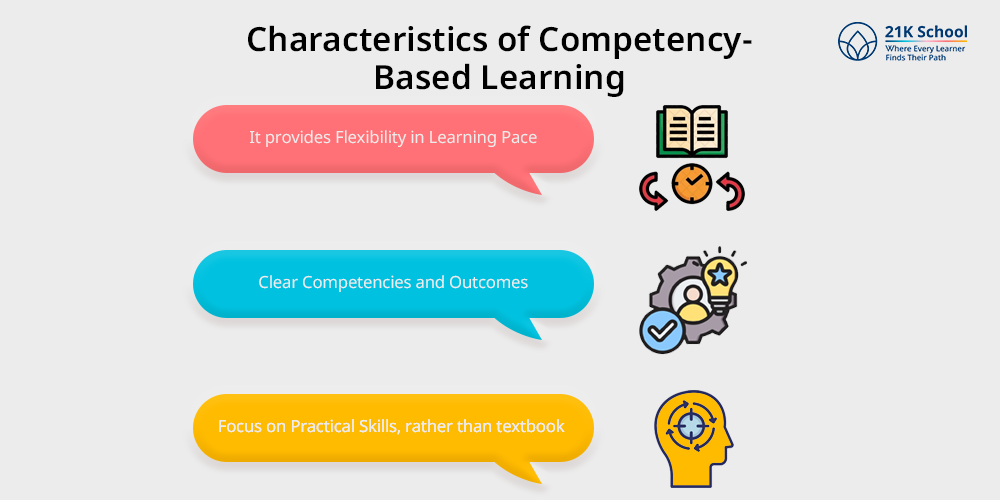
The main features include clearly defined competencies, measurable learning outcomes, flexible support, ongoing assessment, meaningful feedback, and opportunities to demonstrate mastery through practical or academic tasks.
Is competency-based education better than traditional education?
Neither approach is automatically better in every situation. Competency-based education can offer clearer learning targets and more individualized support, but it requires effective assessment, teacher preparation, and careful planning. The best approach depends on the learners, subject, educational goals, and quality of implementation.
How do teachers measure competency?
Teachers use evidence such as tests, projects, portfolios, presentations, practical demonstrations, and written explanations. The assessment should match the competency and use clear criteria to determine whether the student has met the expected standard.
Can competency-based education be used in online courses?
Yes. Online courses can use quizzes, projects, simulations, digital portfolios, and instructor-reviewed assignments to assess mastery. Successful implementation requires clear learning outcomes, suitable assessment methods, and timely feedback.
Does competency-based education allow students to learn at their own pace?
Some competency-based programs allow students to progress at different speeds, depending on when they demonstrate mastery. Others operate within fixed schedules or include credit and time requirements. Flexibility depends on the design of the program.
What is the difference between competency-based education and skills-based learning?
Skills-based learning emphasizes developing particular abilities, while competency-based education usually defines broader outcomes that may combine knowledge, skills, and their application. A competency might require students not only to perform a task but also to explain the principles behind it and make appropriate decisions.
Conclusion
Competency-based education shifts attention from simply completing lessons to demonstrating meaningful learning. By establishing clear expectations, providing targeted instruction, and assessing what students can actually do, this approach helps educators make learning progress more visible and actionable.
Its applications range from foundational skills in elementary school to advanced academic projects, online courses, and professional training. When teachers use reliable assessments, consistent standards, and timely feedback, students gain clearer goals and more opportunities to improve.
For schools considering competency-based education, the most effective starting point is to define a meaningful competency, communicate success criteria, and give students opportunities to practice, receive feedback, and demonstrate mastery. With thoughtful planning and continuous improvement, competency-based learning can support deeper understanding, greater student responsibility, and stronger connections between education and real-world needs.
