
Introduction
Students often study mathematics, science, language arts, history, and geography as separate subjects. Although each subject develops important knowledge and skills, real-world problems rarely fit into a single academic category. Understanding climate change, designing a sustainable building, managing money, or improving a local community requires knowledge from multiple fields.
This is where interdisciplinary learning becomes valuable. By connecting different subjects through shared themes, meaningful questions, and practical projects, teachers help students understand how academic knowledge works together beyond the classroom.
Interdisciplinary learning in schools is an educational approach that integrates knowledge, methods, and skills from two or more subjects to help students explore a topic or solve a problem more comprehensively. Instead of treating every lesson as an isolated experience, students learn to recognize relationships between ideas and apply what they know in new situations.
When carefully planned, interdisciplinary learning can support critical thinking, creativity, collaboration, and deeper understanding. It also gives students opportunities to explore their interests while developing the academic foundations they need for future learning.
What Is Interdisciplinary Learning?
Interdisciplinary learning combines concepts, skills, and perspectives from multiple academic disciplines within a connected learning experience. Teachers organize instruction around a common question, theme, challenge, or project that requires students to use knowledge from different subjects.
For example, a unit about clean water might include science lessons about water quality, mathematics activities involving measurements and data analysis, geography lessons about water distribution, and language arts assignments in which students write persuasive proposals.
Each subject contributes something different to the investigation. Science helps students understand water contamination, mathematics allows them to interpret evidence, geography explains how water resources vary between regions, and writing helps them communicate possible solutions.
The goal is not simply to teach several subjects at the same time. Effective interdisciplinary learning creates meaningful connections between them.
Students should understand how the disciplines relate to one another, why each perspective matters, and how combining different types of knowledge helps them reach stronger conclusions.
Why Connecting School Subjects Matters
Traditional subject-based instruction gives students opportunities to develop specialized knowledge. However, students may sometimes struggle to recognize how that knowledge applies outside the classroom.
Interdisciplinary teaching addresses this challenge by placing academic concepts in a broader context.
Making Learning More Relevant
Students are more likely to understand the purpose of a concept when they can see how it relates to a meaningful question or real-life situation.
For example, learning percentages in mathematics can feel abstract when students only complete numerical exercises. When they use percentages to compare discounts, analyze household budgets, or interpret environmental statistics, they can see how mathematical skills support everyday decisions.
Connecting subjects helps students recognize that classroom knowledge has practical value.
Building a More Complete Understanding
Many important topics involve scientific, social, historical, mathematical, and cultural dimensions.
Studying a city, for example, may involve geography, population statistics, historical development, transportation systems, environmental planning, and public policy. Examining the topic through several disciplines gives students a more complete understanding than studying each dimension independently.
These connections also help learners recognize that complex questions may have several valid perspectives.
Encouraging Curiosity
Interdisciplinary activities can create opportunities for students to ask questions that extend beyond a single subject.
A lesson about ancient civilizations might lead students to investigate architecture, engineering, trade, literature, mathematics, and cultural traditions. One question can inspire further exploration across the curriculum.
Teachers can use this curiosity to develop inquiry-based activities, research assignments, and collaborative projects.
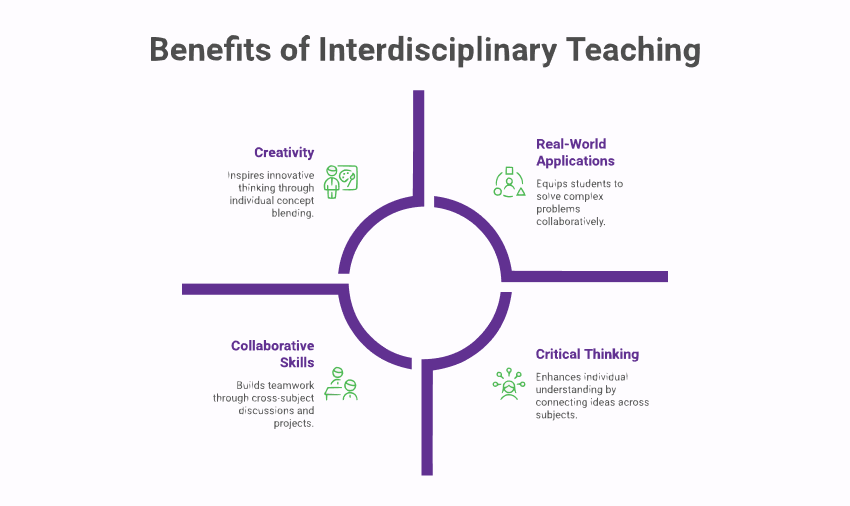
Benefits of Interdisciplinary Learning in Schools
Interdisciplinary learning can provide several educational benefits when activities have clear learning goals and meaningful connections between subjects. Its success depends on the quality of instruction, assessment, and implementation rather than simply combining different topics.
1. Develops Critical Thinking Skills
Critical thinking requires students to examine evidence, compare explanations, identify patterns, and make reasoned decisions.
Interdisciplinary activities encourage students to consider information from different perspectives. For example, when investigating local traffic congestion, students might analyze traffic counts, study road layouts, research the history of urban development, and evaluate proposals for improving transportation.
They must determine which evidence is relevant, consider competing explanations, and justify their recommendations.
These experiences help students practice reasoning instead of relying only on memorized answers.
2. Strengthens Problem-Solving Abilities
Real-world problems often require several kinds of knowledge. Interdisciplinary projects allow students to combine what they have learned to develop practical solutions.
A school that wants to reduce waste might ask students to measure the amount of rubbish produced, classify different materials, research recycling methods, calculate possible cost savings, and create an awareness campaign.
Each activity contributes to the larger challenge.
Students learn to break a complex problem into manageable parts, choose appropriate methods, and evaluate whether their solutions are effective.
3. Improves Engagement and Motivation
Connecting subjects to topics students care about can make classroom activities more interesting.
Students who enjoy art may become more interested in geometry when they explore patterns, symmetry, and architectural design. Students interested in sports may engage more deeply with mathematics when calculating averages, comparing performance statistics, or examining the physics of movement.
These connections provide different ways for learners to participate while maintaining meaningful academic expectations.
However, engagement alone is not enough. Activities should still require students to develop subject knowledge and demonstrate what they have learned.
4. Encourages Creativity and Innovation
Creativity involves generating ideas, exploring alternatives, and combining existing knowledge in new ways.
Interdisciplinary projects provide opportunities for students to design models, create presentations, develop prototypes, write stories based on historical research, or propose solutions to environmental challenges.
For example, a project about sustainable housing could combine engineering principles, mathematical measurements, environmental science, and visual design.
Students can experiment with different approaches and explain why they selected a particular solution.
5. Builds Communication and Collaboration
Many interdisciplinary activities involve group research, shared planning, and presentations. Students must explain their ideas, listen to different viewpoints, divide responsibilities, and agree on decisions.
These activities help develop communication, teamwork, and constructive disagreement.
Teachers can strengthen these skills by assigning clear roles, establishing shared expectations, and asking each student to explain their individual contribution.
Group work should also include individual accountability so that every learner develops and demonstrates the intended competencies.
6. Helps Students Apply Knowledge in New Contexts
Students may understand a concept in one lesson but struggle to use it in a different situation.
Interdisciplinary learning gives them opportunities to transfer knowledge across subjects and settings. For example, students who learn about ratios in mathematics can apply them when adjusting a recipe, mixing materials, or creating a scale model.
Repeated application helps students recognize when a particular concept or method is useful.
Examples of Interdisciplinary Learning Across School Subjects
Teachers can integrate subjects in many ways without abandoning the learning objectives of individual disciplines. The following examples demonstrate how meaningful connections can be developed across the curriculum.
Science and Mathematics: Investigating the Environment
Students investigate the quality of water in a local area or examine patterns in weather data.
In science, they study environmental processes and identify possible causes of changes. In mathematics, they collect measurements, calculate averages, organize information into tables, and create graphs.
They may then compare results, explain patterns, and present evidence-based conclusions.
This project develops scientific reasoning while reinforcing mathematical skills such as measurement, data interpretation, and statistical thinking.
History and Language Arts: Understanding Historical Perspectives
Students explore a historical event through primary accounts, biographies, speeches, letters, or newspaper reports.
History lessons provide the background needed to understand the event, while language arts activities focus on reading comprehension, persuasive writing, narrative structure, and evaluating the reliability of sources.
Students might write a historical diary entry based on documented evidence or compare how different people experienced the same event.
Teachers should distinguish historical facts from creative interpretation so students understand the difference between evidence and imagination.
Geography and Mathematics: Exploring Population Patterns
Students investigate population growth, migration, or urban development.
Geography helps them understand the location, movement, and distribution of people. Mathematics supports the analysis of population data, percentages, ratios, and trends.
Students can create maps, compare regional statistics, and explain how population changes affect housing, transportation, schools, and public services.
This approach shows how numerical evidence can help explain geographical and social patterns.
Art and Science: Exploring Color, Light, and Design
A unit on light and color can connect scientific concepts with visual creativity.
Students investigate reflection, absorption, color mixing, or the behavior of light. They then apply these ideas when producing artwork, designing patterns, or experimenting with different materials.
The scientific component helps explain why certain visual effects occur, while art encourages students to experiment with composition, texture, and expression.
Both disciplines retain their distinct goals while contributing to a shared investigation.
Technology and Language Arts: Creating Digital Stories
Students research a topic, develop a narrative, write a script, and produce a digital story using appropriate technology.
Language arts lessons support writing, editing, vocabulary, and audience awareness. Technology lessons develop skills in digital production, audio recording, visual organization, and responsible media use.
Students must communicate accurate information clearly while making effective design choices.
Teachers can assess both the quality of the written content and the appropriate use of digital tools.
Mathematics and Physical Education: Understanding Sports Performance
Sports offer natural opportunities to connect physical activity with mathematical concepts.
Students can record running times, measure distances, calculate averages, compare scores, or create graphs showing changes in performance.
Physical education provides the context for understanding movement and training, while mathematics supports accurate measurement and interpretation.
Teachers should emphasize personal improvement, fair comparisons, and appropriate participation rather than focusing only on competition.
Literature and Social Studies: Exploring Culture and Society
Students read stories, novels, poems, or plays that reflect particular historical periods and social experiences.
Social studies provides context about institutions, cultural traditions, economic conditions, and historical events. Literature encourages students to examine character motivations, themes, language, and different perspectives.
Students may compare how authors represent a social issue or write evidence-based responses about the relationship between a text and its historical setting.
This connection can strengthen reading comprehension while deepening cultural and historical understanding.
How Teachers Can Implement Interdisciplinary Learning
Successful interdisciplinary instruction requires planning. Teachers should begin with clear learning outcomes and identify genuine connections between subjects rather than combining topics simply for variety.
Step 1: Choose a Meaningful Theme or Problem
Start with a topic that connects naturally to multiple subjects and is appropriate for students’ age and abilities.
Possible themes include sustainable communities, healthy lifestyles, local history, renewable energy, food production, or the design of accessible public spaces.
A useful guiding question is: What could students understand or accomplish more effectively by combining knowledge from different subjects?
The answer helps determine whether an interdisciplinary approach is appropriate.
Step 2: Identify the Learning Objectives for Each Subject
Before designing activities, teachers should identify the specific knowledge and skills students need to develop.
For a project about renewable energy, science objectives might involve understanding energy sources and energy transformation. Mathematics objectives might include interpreting numerical data, comparing costs, or calculating percentages. Language arts objectives could involve writing an evidence-based report or presenting a reasoned argument.
Each subject should make a meaningful contribution to the overall project.
Step 3: Design Activities That Require Students to Make Connections
Students should do more than complete separate assignments under a shared theme.
Plan activities that require them to combine information from different subjects. For example, students investigating school energy use could measure consumption, calculate potential savings, study the environmental impact of energy sources, and propose changes supported by evidence.
The final task should make the relationship between the subjects clear.
Step 4: Collaborate With Other Teachers
Teachers from different subject areas can work together to develop a coherent learning experience.
They can agree on common objectives, coordinate lesson schedules, share resources, and establish consistent expectations for student work.
A mathematics teacher might help design a data-analysis task, while a science teacher supports the investigation and a language arts teacher guides report writing.
When shared planning time is limited, teachers can begin with a small unit involving two subjects before expanding the approach.
Step 5: Provide Appropriate Guidance and Resources
Students need access to reliable information, suitable materials, clear instructions, and appropriate levels of support.
Teachers can provide research guides, sample work, graphic organizers, vocabulary lists, data sheets, or step-by-step instructions. Younger learners may benefit from structured choices, while older students can take greater responsibility for planning and research.
Guidance should help students work independently without removing the challenge of thinking through the problem.
Step 6: Assess Learning Across the Connected Subjects
Assessment should reflect the objectives established for each discipline.
A project about sustainable housing might be evaluated for scientific accuracy, mathematical reasoning, design quality, research skills, and communication.
Rubrics can make expectations transparent and help students understand how different elements contribute to the final result.
Teachers should also assess individual understanding through explanations, short reflections, quizzes, or individual presentations. This helps ensure that group projects produce meaningful learning for every student.
Interdisciplinary Learning and Project-Based Learning
Interdisciplinary learning and project-based learning are closely related, but they are not the same.
Interdisciplinary learning focuses on connecting knowledge and skills from multiple subjects. It describes how different disciplines contribute to understanding a topic or solving a problem.
Project-based learning organizes learning around an extended project through which students investigate a question, develop a product, or present a solution. A project may involve one subject or several.
For example, students might complete a science project investigating plant growth without integrating other subjects in a substantial way. Alternatively, a project about designing a school garden could combine biology, geometry, budgeting, persuasive writing, and visual design.
The second example is interdisciplinary because the different subjects contribute to a connected outcome.
Teachers can use project-based learning to support interdisciplinary instruction, but they should ensure that the project includes clear subject-specific learning goals and meaningful integration.
Challenges of Interdisciplinary Learning and How to Address Them
Although interdisciplinary learning offers useful opportunities, it can be difficult to implement without careful planning.
Limited Planning Time
Teachers may have separate timetables, curriculum requirements, and assessment schedules. Coordinating a shared project can therefore be challenging.
Practical solution: Start with a short unit that connects two subjects. Agree on a small number of shared objectives and reuse suitable materials where possible. A common planning document can help teachers coordinate responsibilities.
Maintaining Subject Depth
A project can become broad and entertaining without developing important academic knowledge. Students might produce an attractive presentation while learning very little about the underlying concepts.
Practical solution: Identify the essential learning objectives for each subject before designing activities. Check that students practice the relevant skills and demonstrate subject-specific understanding.
Unequal Participation in Group Work
Some students may take responsibility for most of the work, while others contribute very little.
Practical solution: Assign clear roles, use progress checkpoints, collect individual reflections, and assess both group outcomes and individual learning. Rotate responsibilities so students develop a range of skills.
Difficulties With Assessment
A single project may involve several subjects, making it difficult to determine what each student has learned.
Practical solution: Use a shared project rubric with separate criteria for each discipline. Supplement the final product with individual questions, short tests, or oral explanations.
Limited Resources
Some projects require equipment, digital tools, or access to locations that schools cannot easily provide.
Practical solution: Choose projects that use available classroom materials, public information, local observations, or low-cost activities. Effective interdisciplinary learning depends on meaningful connections, not expensive resources.
How Technology Can Support Interdisciplinary Learning
Digital tools can make it easier for students to research, organize, analyze, and present information across subject areas.
Online research resources can help students investigate historical events, scientific questions, and geographical patterns. Spreadsheet applications allow them to organize measurements, calculate statistics, and create charts. Presentation and design tools support communication, while collaborative documents allow students to plan and revise work together.
Digital maps can support geographical investigations, and simulations can help students explore systems that are difficult to observe directly.
Technology should be selected according to the learning objective. Teachers should also address source reliability, privacy, accessibility, and responsible digital behavior.
A digital presentation is not automatically interdisciplinary. Technology becomes valuable when it helps students make meaningful connections, develop relevant skills, or communicate their findings effectively.
Adapting Interdisciplinary Learning to Different Age Groups
The design of interdisciplinary activities should reflect students’ developmental needs, prior knowledge, and ability to work independently.
Elementary School Students
Young learners often benefit from familiar themes, hands-on exploration, stories, observation, and guided activities.
A project about the weather could combine basic science, daily temperature measurements, drawing, vocabulary development, and simple charts. Teachers can use questions, visual aids, and structured tasks to help students identify connections.
Middle School Students
Middle school students can investigate more complex questions and begin working with multiple sources of evidence.
A project about reducing school waste could include classifying materials, measuring waste quantities, calculating percentages, researching environmental effects, and designing an awareness campaign.
Students can take greater responsibility for research and collaboration while receiving guidance on organization and evaluation.
High School Students
Older students can engage in extended investigations involving competing perspectives, more complex data, independent research, and evidence-based decision-making.
For example, a project examining urban transportation could connect economics, geography, environmental science, statistics, and public policy. Students might compare transportation options and recommend improvements using evidence from several disciplines.
Teachers should maintain clear academic standards and provide appropriate support for research, analysis, and communication.
A Sample Interdisciplinary Project: Designing a Sustainable School
A practical way to understand interdisciplinary learning is to consider a project in which students investigate how their school could become more sustainable.
Project question: How can we make our school more environmentally responsible while considering cost, practicality, and student needs?
Subjects involved:
- Science: Investigate waste, energy use, water conservation, and environmental impacts.
- Mathematics: Measure resource use, organize data, calculate percentages, and estimate possible savings.
- Geography: Examine the school’s physical environment and identify opportunities for improvement.
- Language arts: Research the issue, write a proposal, and present recommendations supported by evidence.
- Art and design: Create visual plans, diagrams, posters, or models to communicate proposed changes.
- Technology: Use spreadsheets, digital presentations, or design tools to organize and communicate findings.
Learning process: Students begin by observing their school and identifying an environmental issue. They collect relevant information, discuss possible solutions, compare alternatives, and develop a proposal. Teams then present their recommendations to classmates or school leaders.
Assessment: Teachers evaluate the accuracy of the research, the quality of mathematical analysis, the feasibility of proposed solutions, the clarity of communication, and each student’s understanding of the subject concepts.
Expected learning outcomes: Students practice applying academic knowledge, interpreting evidence, collaborating with others, and developing realistic solutions to a shared problem.
The project demonstrates that interdisciplinary learning is most effective when each subject contributes a clear purpose and students must bring those contributions together to reach a meaningful conclusion.
How Schools Can Evaluate Interdisciplinary Learning
Schools should evaluate interdisciplinary learning by examining both student outcomes and the quality of the learning experience.
Useful indicators include:
- Subject understanding: Can students explain the key concepts and skills from each participating subject?
- Connections between disciplines: Can students explain how knowledge from different subjects supports their conclusions?
- Application of knowledge: Can they use what they learned in a new or realistic situation?
- Quality of reasoning: Do they use evidence, compare alternatives, and justify decisions?
- Collaboration and communication: Can they contribute effectively, explain their thinking, and respond to feedback?
- Student reflection: Can they identify what they learned and explain how the different subjects contributed?
Teachers can collect evidence through rubrics, written assignments, project products, presentations, observation, and individual reflections.
Schools should also review implementation. Teachers can discuss which subject connections were meaningful, where students struggled, and whether the project met the intended curriculum goals.
Evaluation helps schools improve future activities and avoid treating interdisciplinary learning as a one-time event rather than a purposeful instructional approach.
Frequently Asked Questions About Interdisciplinary Learning
What is interdisciplinary learning in schools?
Interdisciplinary learning in schools is an approach that connects two or more academic subjects through a shared question, theme, or problem. Students combine knowledge and skills from different disciplines to develop a more complete understanding or produce a meaningful outcome.
What is an example of interdisciplinary learning?
A project about climate change is one example. Students can study the science of climate systems, analyze temperature data in mathematics, examine geographical impacts, investigate historical energy use, and write evidence-based recommendations in language arts.
What are the main benefits of interdisciplinary learning?
Potential benefits include stronger connections between concepts, opportunities to apply knowledge, critical thinking, creativity, collaboration, and increased relevance of classroom learning. Results depend on the quality of the activities, teaching, and assessment.
Is interdisciplinary learning suitable for elementary students?
Yes. Elementary students can explore connections through stories, practical activities, observation, drawing, simple measurements, and guided projects. Activities should be appropriate for their age and should reinforce clear learning objectives.
How is interdisciplinary learning different from multidisciplinary learning?
In multidisciplinary learning, several subjects may examine the same theme while largely retaining their separate perspectives. Interdisciplinary learning places greater emphasis on connecting and integrating knowledge or methods from those subjects. In practice, schools sometimes use these terms differently.
How can teachers assess interdisciplinary projects?
Teachers can use rubrics that assess subject-specific knowledge, the quality of connections between disciplines, problem-solving, research, communication, and the final product. Individual reflections or short assessments can also show what each student has learned.
Does interdisciplinary learning replace traditional subjects?
No. Interdisciplinary learning does not require schools to eliminate subject-based instruction. Students still need strong foundations in individual disciplines. Interdisciplinary activities build on those foundations by showing how knowledge and skills work together.
Conclusion
Interdisciplinary learning helps students understand that knowledge does not exist in isolated categories. Mathematics can explain patterns in science, history can provide context for literature, technology can support research, and art can communicate complex ideas. When these connections are meaningful, students gain opportunities to apply what they learn in broader contexts.
Effective interdisciplinary learning in schools begins with clear objectives, purposeful subject connections, collaborative planning, and appropriate assessment. Teachers should ensure that every participating discipline contributes meaningful knowledge and that students demonstrate both individual understanding and the ability to connect ideas.
Schools can begin with a manageable project involving two subjects and expand as teachers gain experience. By combining strong subject foundations with opportunities for integrated thinking, educators can create learning experiences that are relevant, challenging, and useful beyond the classroom.
