
Introduction
Learning involves more than reading information, listening to a teacher, or completing assignments. For students to develop lasting knowledge, they need to process new information, connect it with what they already know, and retain it so they can use it later. Memory plays a central role in this process, influencing how students understand concepts, solve problems, and apply knowledge in different situations.
Understanding memory and learning in education helps teachers design lessons that support meaningful learning rather than short-term memorization. It also helps students choose study techniques that make better use of their time. Strategies such as spaced practice, active recall, meaningful explanation, and regular feedback can help learners strengthen their knowledge over time.
Memory is not a perfect recording of everything a person experiences. It is an active process influenced by attention, prior knowledge, sleep, emotions, practice, and the way information is presented. Some information is quickly forgotten, while other knowledge becomes easier to retrieve through repeated and meaningful use.
This article explains how memory works during learning, explores the major types and stages of memory, and examines practical strategies teachers and students can use to improve knowledge retention and academic performance.
What Is the Relationship Between Memory and Learning in Education?
Memory is the ability to encode, retain, and retrieve information. Learning involves acquiring knowledge or skills that produce a relatively lasting change in what a person understands or can do.
These processes are closely connected. When students learn a new mathematical formula, for example, they must understand its meaning, retain the relevant information, and retrieve it when solving a problem. If they cannot recall the necessary concept or procedure, applying it independently becomes difficult.
However, remembering information and understanding it are not exactly the same. A student might memorize a definition without being able to explain it or apply it to a new situation. Effective education therefore aims to develop both accurate recall and deeper understanding.
Memory supports learning in several important ways:
- Knowledge retention: Students preserve information beyond the lesson in which it was introduced.
- Conceptual understanding: Learners connect new ideas with existing knowledge.
- Skill development: Practice helps students perform procedures with greater accuracy and fluency.
- Problem-solving: Students draw on previously learned information to approach unfamiliar challenges.
- Transfer of learning: Learners apply knowledge in different contexts rather than only repeating familiar examples.
Teachers can support these outcomes by helping students process information meaningfully, revisit important concepts, and practice using what they have learned.
The Three Main Stages of Memory
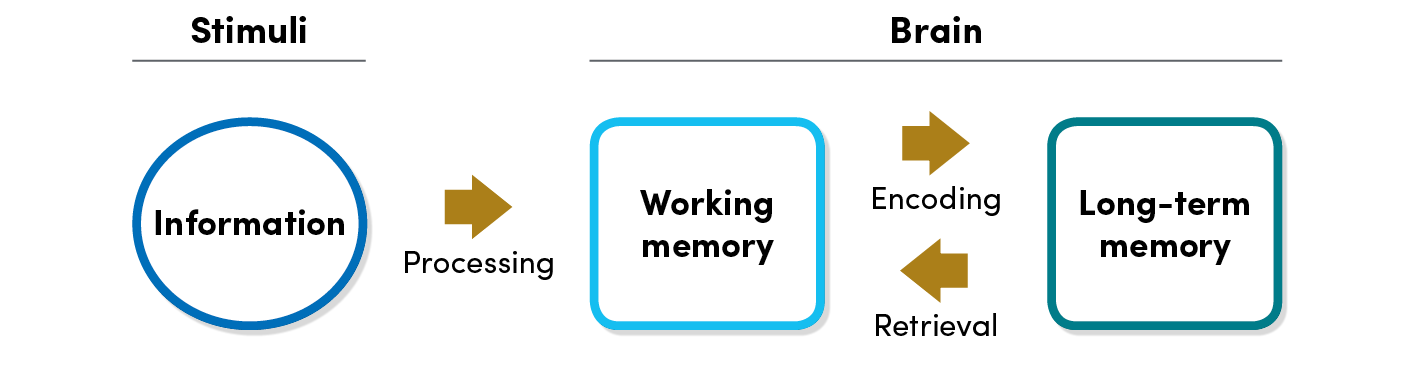
Memory is often described through three broad processes: encoding, storage, and retrieval. Each stage contributes to how information becomes available for future learning.
1. Encoding: How the Brain Processes New Information
Encoding is the process through which information is taken in and represented in memory. It begins when students notice information through reading, listening, observing, or participating in an activity.
Attention is important during this stage. If students are distracted, overloaded with information, or unsure what they should focus on, they may not process essential details effectively.
For example, a student learning about the water cycle may remember more when the teacher explains evaporation and condensation using a diagram, connects the concepts to everyday weather, and asks questions about each stage.
Encoding can be supported by:
- Connecting new information with prior knowledge.
- Explaining concepts in the student’s own words.
- Using meaningful examples and comparisons.
- Organizing information into related groups.
- Combining appropriate visual representations with verbal explanations.
- Asking questions that require students to think about the material.
Simply seeing or hearing information does not guarantee that it has been learned. Students need opportunities to pay attention, interpret meaning, and organize what they encounter.
2. Storage: How Information Is Retained
Storage refers to maintaining information over time. Some information remains available only briefly, while other information can be retained for days, months, or years.
Repeated exposure can contribute to learning, but repetition alone is not always sufficient. Students are more likely to develop durable knowledge when they actively work with information, connect it to existing understanding, and revisit it over time.
For example, a student may initially learn the meaning of a scientific term during a lesson. If the term is used again in a classroom discussion, retrieved during a later quiz, and applied in an experiment, the student has additional opportunities to strengthen and organize that knowledge.
Teachers can support storage by revisiting essential concepts, providing cumulative practice, and helping students connect related ideas across different lessons.
3. Retrieval: How Students Recall What They Have Learned
Retrieval is the process of bringing stored information back into active awareness. Students use retrieval when answering a question, explaining a concept without notes, solving a problem, or remembering a procedure.
Retrieval is not simply the final step in learning. Research indicates that attempting to recall information can itself strengthen later retention, especially when practice is repeated over time and students receive corrective feedback.
For example, after teaching the causes of a historical event, a teacher might ask students to explain the main causes from memory before reviewing their notes. This activity helps students identify what they can recall and what still needs attention.
Useful retrieval activities include:
- Short, low-pressure quizzes.
- Flashcards that require students to produce an answer.
- Writing a summary from memory.
- Answering questions without looking at notes.
- Explaining a concept to a partner.
- Solving previously studied problems without checking the solution first.
When students struggle to retrieve an answer, teachers can provide hints, revisit the material, and allow another attempt. The purpose is to improve learning, not to embarrass students or turn every recall activity into a high-stakes assessment.
Understanding Different Types of Memory
Memory includes several systems that perform different functions. Understanding these differences helps teachers design learning activities that match students’ needs.
Sensory Memory
Sensory memory briefly holds information received through the senses, such as sounds, images, and other environmental signals.
Most sensory information disappears quickly unless attention is directed toward it. In a classroom, students may hear many sounds or see numerous objects, but they cannot process every detail equally.
Teachers can help direct attention by highlighting essential information, using clear explanations, removing unnecessary distractions, and signaling important transitions between topics.
Short-Term Memory
Short-term memory refers to the brief maintenance of a limited amount of information. For example, a student may remember a short instruction long enough to carry it out.
Its capacity is limited, so presenting too many unfamiliar ideas at once can make learning difficult.
Teachers can reduce unnecessary demands by breaking instructions into manageable steps, using clear examples, and checking understanding before introducing additional material.
Working Memory
Working memory is used to hold and mentally work with information during an ongoing task. Students rely on it when following a sequence of mathematical steps, comparing arguments, or interpreting a sentence while reading.
Working memory is especially important for complex learning because students often need to combine new information with what they already know.
For example, solving a multi-step algebra problem requires learners to remember the goal, follow mathematical procedures, and monitor their progress.
Teachers can support working memory by:
- Dividing complex tasks into smaller stages.
- Demonstrating procedures before independent practice.
- Providing written instructions when appropriate.
- Using worked examples for unfamiliar problems.
- Teaching essential background knowledge before introducing advanced concepts.
- Gradually reducing support as students become more confident.
These strategies reduce unnecessary mental demands and allow students to focus on understanding the material.
Long-Term Memory
Long-term memory supports the retention of knowledge and skills over extended periods. It includes facts, concepts, personal experiences, and learned procedures.
Students use long-term memory when they recall multiplication facts, recognize grammatical patterns, explain scientific principles, or perform a familiar skill.
Knowledge stored in long-term memory can also help working memory operate more efficiently. When students understand foundational concepts, they do not need to treat every part of a new problem as unfamiliar.
Developing durable long-term memory requires meaningful learning opportunities, appropriate practice, and repeated retrieval. Teachers should therefore revisit important knowledge rather than assuming that a concept is permanently learned after one lesson.
Why Students Forget What They Have Learned
Forgetting is a normal part of memory. Students may understand a topic during class but struggle to remember it several days later. This does not necessarily mean they failed to learn; it may indicate that the information has not been sufficiently reinforced or that they need better retrieval cues.
Several factors can contribute to forgetting.
Lack of Practice
Information that is not revisited may become more difficult to retrieve. Students who study a topic once and then move on without review may struggle to recall it later.
Regular practice distributed across several days can help maintain access to important information.
Weak Initial Understanding
When students memorize words without understanding their meaning, the information may be difficult to use in unfamiliar situations.
Connecting definitions with examples, explanations, and applications can create a stronger foundation for future learning.
Interference From Similar Information
New or previously learned information can sometimes interfere with recall. Students learning several similar mathematical rules or vocabulary terms may confuse them if they do not understand the differences.
Teachers can address this challenge by explicitly comparing related concepts and giving students opportunities to distinguish between them.
Distractions and Divided Attention
Frequent interruptions can make it difficult to process information effectively. Switching repeatedly between a lesson, notifications, and unrelated tasks may reduce the attention available for learning.
Focused study periods and a suitable learning environment can help students engage more deeply with the material.
Stress and Fatigue
High levels of stress, insufficient rest, and fatigue can interfere with attention, learning, and recall. A student who feels overwhelmed may struggle to retrieve information that they previously understood.
Supportive teaching, manageable workloads, reasonable breaks, and healthy sleep habits can contribute to better learning conditions.
Evidence-Based Strategies to Improve Memory and Learning in Education
Teachers and students can use several research-supported strategies to improve retention. The most useful approach depends on the subject, the learner’s existing knowledge, and the type of learning required.
1. Use Spaced Practice Instead of Last-Minute Cramming
Spaced practice involves revisiting information across multiple study sessions rather than concentrating all practice into one long session.
For example, a student preparing for a science examination might review a concept on Monday, practice recalling it on Wednesday, revisit it on Saturday, and test their understanding again the following week.
Spacing gives learners repeated opportunities to retrieve information after some time has passed. Research reviews identify spaced practice as an effective approach for improving long-term retention across many learning situations.
A practical study schedule might look like this:
| Study session | Main activity |
|---|---|
| Day 1 | Learn the concept and complete guided examples. |
| Day 2 | Recall the main ideas without notes. |
| Day 4 | Answer practice questions and correct mistakes. |
| Day 7 | Review difficult points and solve new examples. |
| Day 14 | Complete a short cumulative quiz. |
This is a flexible example rather than a universal schedule. The ideal spacing depends on how difficult the material is and how long students need to retain it.
2. Practice Active Recall
Active recall requires students to retrieve information from memory rather than simply rereading it.
A student studying biology, for example, could close their textbook and explain the function of each major cell structure. They could then check their answers and correct any misunderstandings.
Active recall is useful because it reveals what students can actually remember. Familiarity with a page or set of notes can create the impression of learning even when independent recall remains difficult.
Students can practice active recall by:
- Answering questions before checking the textbook.
- Using flashcards with clear prompts.
- Writing everything they remember about a topic.
- Explaining a process aloud.
- Completing practice tests.
- Reconstructing diagrams from memory.
The most effective practice includes feedback so that incorrect answers can be corrected before they become persistent misconceptions.
3. Connect New Knowledge With Existing Knowledge
Learning becomes more meaningful when students can relate new information to concepts they already understand.
For example, a teacher introducing electrical circuits might compare a simple circuit to a complete path through which current can flow. The comparison can help students develop an initial understanding before exploring the more detailed scientific explanation.
Students can make these connections by asking:
- What does this remind me of?
- How is this idea similar to something I already know?
- What makes these two concepts different?
- Where could I use this information?
- Can I explain the idea in my own words?
Teachers should ensure that comparisons are accurate and clarify their limitations. An analogy can introduce an idea, but students also need to understand the actual concept.
4. Use Elaboration to Deepen Understanding
Elaboration involves explaining why something is true, how it works, or how it relates to other ideas.
Instead of memorizing that plants need light for photosynthesis, students can explain how light energy contributes to the process and why changes in light availability may affect plant growth.
Elaboration encourages learners to build relationships between pieces of information rather than treating each fact as an isolated item.
Teachers can promote elaboration through questions such as:
- Why does this happen?
- How does this process work?
- What evidence supports this explanation?
- How would the result change under different conditions?
- How does this idea relate to another topic?
These questions can be used in classroom discussions, written assignments, and independent study.
5. Combine Words and Visual Representations
Diagrams, timelines, maps, charts, and labeled illustrations can help students understand relationships that are difficult to communicate through text alone.
For example, a labeled diagram can show the stages of the water cycle, while a timeline can clarify the order of historical events.
Visuals are most helpful when they support the learning objective and are clearly connected to explanations. Decorative images or crowded slides can distract from the information students need to understand.
Teachers should also avoid presenting too much text and too many visual elements at the same time. Clear layouts, concise labels, and guided explanations can make learning materials easier to follow.
6. Break Complex Information Into Manageable Sections
Students may struggle when a lesson introduces too many unfamiliar concepts at once. Breaking material into smaller, connected sections can make complex learning more manageable.
For example, a lesson on the human circulatory system could begin with the main function of the heart, continue with the movement of blood, and then explore how blood vessels support circulation.
After each section, students can answer a brief question or summarize the main idea before moving forward.
This approach helps teachers identify misunderstandings early and gives students opportunities to organize what they have learned.
The goal is not to remove all difficulty. Students still need challenging tasks, but those tasks should build on an understandable foundation.
7. Interleave Related Topics
Interleaving means mixing practice across different but related problem types rather than completing many identical questions in a row.
For example, students might practice several types of mathematics problems in one session, deciding which method is appropriate for each question.
This requires learners to recognize differences between problems and select a suitable strategy.
Interleaving can be especially useful after students have developed basic familiarity with each topic. Beginners may first need focused practice to understand a procedure before they can benefit from comparing it with alternatives.
8. Use Feedback to Correct Mistakes
Feedback helps students understand what they have done correctly, where their reasoning needs improvement, and what to do next.
Effective feedback is specific and actionable. Instead of simply marking an answer wrong, a teacher might explain which step contains the error and ask the student to try again using the correct principle.
Students should also have time to use the feedback. Receiving a correction without revisiting the question may not be enough to improve understanding.
Teachers can encourage students to maintain a mistake log that records common errors, the reason each error occurred, and the strategy used to correct it.
Over time, this process can help learners identify patterns in their difficulties and take greater responsibility for improvement.
The Role of Sleep, Attention, and Emotions in Memory
Learning strategies are important, but memory is also influenced by the conditions in which students learn.
Sleep and Memory Consolidation
Sleep supports several processes involved in learning and memory. During sleep, the brain can reorganize and stabilize aspects of newly acquired information.
Insufficient sleep can make it harder for students to concentrate, learn new material, and retrieve information efficiently.
Students can support learning by maintaining regular sleep schedules and avoiding the assumption that studying throughout the night is always more productive than resting.
Teachers can reinforce healthy study habits by encouraging learners to begin preparing for examinations early rather than relying on last-minute cramming.
Attention and Focus
Attention helps determine which information receives deeper processing. When students are distracted, they may miss important explanations or fail to connect ideas.
Teachers can support attention by presenting clear lesson goals, organizing materials logically, varying appropriate learning activities, and reducing unnecessary distractions.
Students can use focused study sessions with planned breaks and keep unrelated digital notifications out of reach when possible.
Emotions and Learning
Emotions can influence how students pay attention, interpret experiences, and recall information. Interest and curiosity may encourage learners to engage more deeply, while overwhelming stress can interfere with performance.
A supportive classroom environment helps students ask questions, acknowledge mistakes, and seek clarification without unnecessary fear of embarrassment.
This does not mean that every lesson must be stress-free or entertaining. Productive challenge is part of learning, but students should have the guidance and support needed to work through it.
How Teachers Can Apply Memory Science in the Classroom
Understanding memory becomes most useful when teachers translate it into everyday teaching practices.
Begin Lessons With Retrieval Questions
Start a lesson with two or three questions about material taught previously. These questions help students reactivate prior knowledge and give the teacher information about what learners remember.
The questions can be brief and low-pressure, with answers reviewed together after students have attempted them.
Revisit Important Concepts Across Units
Instead of treating each topic as completely separate, teachers can include earlier concepts in later lessons.
For example, students learning about ecosystems can revisit food chains, energy transfer, and plant growth while exploring a new environmental issue.
This approach helps learners see connections and provides additional opportunities to retrieve earlier knowledge.
Teach Students How to Study
Students may spend considerable time studying without knowing which techniques support long-term retention.
Teachers can demonstrate how to create useful questions, practice recall, space study sessions, and use feedback to correct errors.
Students can compare their confidence with their actual performance to identify which topics need more practice.
Use Low-Stakes Quizzes
Short quizzes can serve as learning activities rather than only as grading tools. When used regularly, they help students practice retrieving information and allow teachers to identify misconceptions.
Questions should cover both recent and earlier material. Feedback should explain the correct reasoning and provide guidance for improvement.
Encourage Reflection on Learning
Reflection helps students think about what they understand and what remains difficult.
At the end of a lesson, learners might answer three questions:
- What is the most important idea I learned?
- What can I explain without looking at my notes?
- What should I review or practice again?
These questions encourage students to monitor their understanding and make more purposeful decisions about future study.
A Practical Memory-Based Study Plan for Students
Students can apply memory principles through a simple routine that balances initial learning, recall, and review.
Step 1: Understand the material. Read the lesson or listen to the explanation carefully. Identify the main concepts and ask questions about anything unclear.
Step 2: Summarize from memory. Close the book and write the key ideas in your own words. Then compare your summary with the original material.
Step 3: Create retrieval questions. Turn important facts and concepts into questions that require you to produce an answer rather than merely recognize it.
Step 4: Review over several days. Return to the questions after increasing intervals, adjusting the schedule according to how easily you can recall the material.
Step 5: Mix related problems. Once the basic concepts are familiar, practice different problem types so you learn when and how to apply each method.
Step 6: Correct mistakes. Review incorrect answers, understand why they were wrong, and attempt similar questions again.
Step 7: Check long-term understanding. After a week or two, test whether you can still explain the main ideas and apply them to unfamiliar examples.
This routine can be adapted to many subjects, including mathematics, science, history, languages, and professional training. Students should adjust the amount of practice according to the complexity of the material and the level of mastery required.
Common Myths About Memory and Learning
Misunderstandings about memory can lead students and teachers to use ineffective study habits. Several common beliefs deserve closer examination.
Myth 1: Rereading Is Enough to Learn
Rereading can help students become familiar with material and clarify misunderstandings. However, familiarity does not always mean that information can be recalled independently.
Combining reading with retrieval practice and feedback gives students a better opportunity to check what they actually know.
Myth 2: Cramming Is the Best Way to Prepare for Exams
Cramming may help students recall information for a test shortly afterward, but it is generally less effective for long-term retention than distributing practice over time.
Starting earlier allows learners to revisit difficult concepts, correct mistakes, and strengthen memory across multiple sessions.
Myth 3: Forgetting Means Learning Has Failed
Forgetting is a normal feature of memory. Students may need repeated practice to make information easier to retrieve.
An incorrect answer can provide useful information about what needs review, especially when students receive guidance and try again.
Myth 4: Every Student Learns Best Through One Fixed Learning Style
Students may have preferences for certain activities, but the claim that each person has one fixed learning style that should determine all instruction is not well supported.
Effective teaching should match methods to the learning objective. Diagrams are useful for understanding spatial relationships, discussion can support explanation, and practical work can help learners develop procedures.
Using varied, appropriate approaches is more useful than labeling students as a single type of learner.
Myth 5: More Study Time Always Means Better Learning
Long study sessions do not guarantee effective learning. Attention may decline, and students may repeat familiar material without addressing their weaknesses.
Focused sessions, meaningful practice, breaks, feedback, and spaced review can make study time more productive.
How to Measure Progress in Memory and Learning
Teachers and students need ways to determine whether learning strategies are helping. Feeling confident during a lesson is not always a reliable indicator of long-term understanding.
Useful ways to evaluate progress include:
- Delayed quizzes: Check whether students can remember material several days after learning it.
- Cumulative assessments: Include questions from earlier units as well as recent lessons.
- Explanation tasks: Ask learners to describe concepts in their own words.
- Application questions: Present unfamiliar examples that require students to use existing knowledge.
- Error analysis: Track recurring mistakes and check whether they decrease over time.
- Self-assessment: Ask students to identify which concepts they can recall independently and which require further practice.
Teachers should use results to adjust instruction and provide support, not simply to label students as successful or unsuccessful.
Students can use the same information to decide what to study next. If they repeatedly forget a concept, they may need a clearer explanation, additional examples, more retrieval practice, or a different way of organizing the information.
Frequently Asked Questions
What is the connection between memory and learning in education?
Memory and learning in education are closely connected because students need to encode, retain, and retrieve information to develop lasting knowledge. Learning activities that encourage understanding, practice, and recall can help students retain information and apply it in new situations.
What are the three main stages of memory?
Memory is commonly described through encoding, storage, and retrieval. Encoding involves processing information, storage involves retaining it over time, and retrieval involves bringing stored information back into awareness when needed.
How can students improve memory for exams?
Students can improve exam preparation by using spaced practice, active recall, practice questions, meaningful explanations, and feedback. Starting early and revisiting material across several sessions is generally more helpful for long-term retention than relying only on last-minute cramming.
Why is active recall effective for learning?
Active recall requires students to retrieve information without immediately consulting their notes. This helps them identify knowledge gaps and provides practice in accessing information later. Reviewing the correct answers afterward can further support learning.
What is spaced repetition in education?
Spaced repetition involves reviewing information at intervals over time. Students might revisit material after a day, several days, and then a longer interval, adjusting the schedule according to their level of recall and the difficulty of the topic.
Does sleep affect memory and learning?
Yes. Sleep supports processes involved in memory consolidation and helps maintain attention and cognitive performance. Poor sleep can make it more difficult to learn new information and retrieve what has been learned.
What role does working memory play in learning?
Working memory allows students to hold and manipulate information while completing a task. It is important for activities such as following instructions, solving multi-step problems, and understanding complex explanations. Breaking tasks into manageable stages can help reduce unnecessary demands on working memory.
How can teachers help students remember information longer?
Teachers can revisit important concepts, use low-stakes retrieval quizzes, provide clear explanations, connect new information with prior knowledge, and encourage students to practice over time. Feedback and opportunities to apply knowledge are also important.
Conclusion
Memory plays a fundamental role in how students acquire knowledge, develop skills, and apply what they learn. Understanding the relationship between memory and learning in education helps teachers create lessons that move beyond short-term memorization and support lasting understanding.
Encoding, storage, and retrieval work together throughout the learning process. Students benefit when they pay attention to new information, connect concepts meaningfully, revisit material over time, and practice recalling knowledge without immediately relying on notes.
Strategies such as spaced practice, active recall, elaboration, appropriate visual representations, and timely feedback can help improve retention when they are matched to the learning task. Sleep, attention, and a supportive learning environment also contribute to effective learning.
There is no single technique that guarantees success for every student or subject. The strongest approach combines clear instruction, purposeful practice, reflection, and regular opportunities to apply knowledge. By making memory science part of everyday teaching and study routines, educators can help students become more independent, confident, and effective learners.
